
What's Happening?
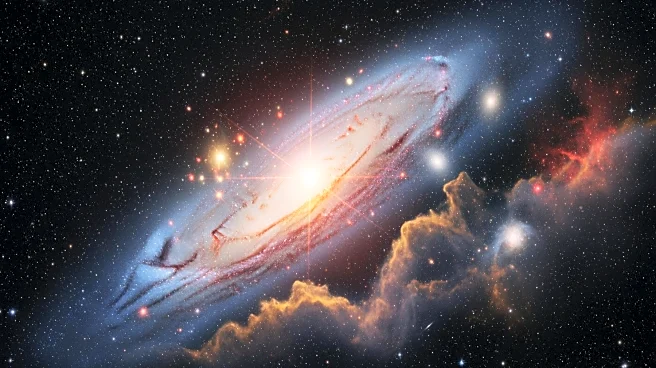
NASA's James Webb Space Telescope has made a groundbreaking observation by identifying a supernova that exploded when the universe was only 730 million years old. This marks the earliest detection of a supernova to
date. The telescope's near-infrared images also allowed astronomers to locate the faint host galaxy of the supernova. The observation was part of a coordinated effort with other international telescopes following a gamma-ray burst detected in March. The gamma-ray burst, a super bright flash of light, was linked to the explosive death of a massive star. Webb's observations were strategically timed to capture the supernova at its brightest, three and a half months after the gamma-ray burst ended.
Why It's Important?
This discovery is significant as it provides insights into the early universe, a period when stars were likely more massive and contained fewer heavy elements. The ability of the James Webb Space Telescope to detect such distant and ancient events demonstrates its capability to unravel mysteries about the universe's origins and the formation of galaxies. The observation also challenges existing theories about early supernovae, as the detected supernova shares similarities with modern ones, prompting further investigation into the characteristics of early stars and galaxies.
What's Next?
The research team plans to continue using the James Webb Space Telescope to study gamma-ray bursts and their associated supernovae in the early universe. These observations will help astronomers learn more about the galaxies that existed during this time. The team aims to capture the afterglow of gamma-ray bursts to gain a 'fingerprint' of the host galaxies, which will provide more detailed information about their composition and structure.
Beyond the Headlines
The detection of this early supernova opens new avenues for understanding the Era of Reionization, a period when the universe transitioned from being opaque to transparent to high-energy light. This era is crucial for understanding the formation of the first stars and galaxies. The similarities between early and modern supernovae suggest that fundamental processes governing star formation and death may have remained consistent over billions of years, offering a unique perspective on cosmic evolution.