






What's Happening?
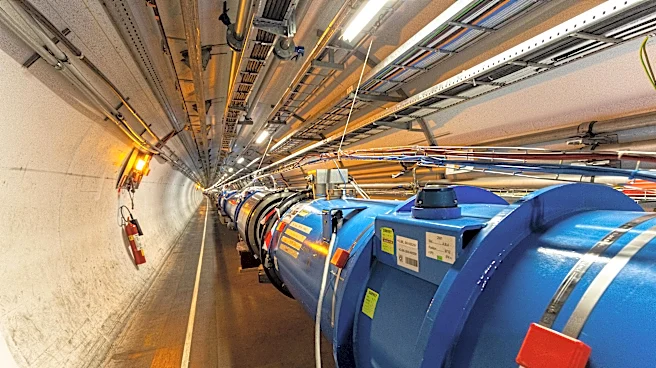
After more than four decades of searching, physicists at CERN's Large Hadron Collider (LHC) have detected the first evidence of an exceptionally rare particle decay, known as Bd to mu mu. This decay, predicted to occur only once in every 10 billion beauty
particles, involves a beauty particle transforming into two muons. The signal, recorded by the upgraded LHCb experiment, has a statistical significance of 3.2 sigma, which qualifies as evidence, though more data is needed to reach the five-sigma threshold for a formal discovery in particle physics. Researchers from the University of Manchester played key roles in the experiment and its upgrade, including developing detector technology. Professor Chris Parkes, head of the Department of Physics and Astronomy at the University of Manchester, likened the rarity of this decay to finding a perfect match on a first romantic date among everyone on Earth. Professor Brian Cox, a particle physicist at the University of Manchester not involved in this specific experiment, highlighted the importance of this result as a beautiful example of scientific advancement through instrument upgrades and detailed observation.
Why It's Important?
This detection is significant because rare decays can offer a means to discover new, undiscovered particles by observing their influence on these unlikely events. The rarer a decay, the more sensitive it is to such effects. Physicists can compare the measured decay rate with predictions from the Standard Model, their current best theory of fundamental particles and interactions. The new measurement aligns with these predictions, but greater precision in future data could reveal discrepancies, indicating where the Standard Model might break down. Such breakthroughs could lead to a deeper understanding of the 'Zeptoverse,' an unexplored realm at extremely short distances where unknown particles and forces might exist. This research expands the fundamental understanding of nature and could pave the way for new physics beyond current knowledge, potentially impacting theoretical frameworks and future technological advancements in particle physics.
What's Next?
The upgraded LHCb experiment is designed to collect data at up to five times its previous rate, aiming to build a much larger dataset into the early 2030s. This increased data collection will allow for more precise measurements of these rare decays, potentially pushing the statistical significance to the five-sigma discovery threshold. A further planned upgrade could increase the data collection rate by another factor of ten, enhancing sensitivity to undiscovered particles at even shorter distances. These future measurements will be crucial for probing the 'Zeptoverse' and identifying any deviations from the Standard Model. The ongoing efforts will continue to test the limits of current physics theories and could lead to the discovery of new fundamental particles or forces, shaping the future direction of particle physics research.
Beyond the Headlines
The pursuit of increasingly precise measurements in particle physics, as exemplified by this discovery, highlights the continuous human endeavor to understand the universe at its most fundamental level. The concept of the 'Zeptoverse' underscores the vast unknown that still exists within the subatomic world, suggesting that current models, while highly successful, may only represent a partial understanding of reality. The collaborative nature of such large-scale experiments, involving international teams and significant technological advancements, also demonstrates the power of global scientific cooperation. Ethically, this research pushes the boundaries of knowledge, potentially leading to new insights that could challenge existing scientific paradigms and foster a deeper appreciation for the complexity of the cosmos. The long-term implications could extend to new technologies or a revised understanding of matter and energy, though these are currently speculative.