
What's Happening?
Physicists at Auburn University have published a study in Physical Review E revealing that weak magnetic fields can significantly alter the behavior of dusty plasmas, a rare state of matter. The research
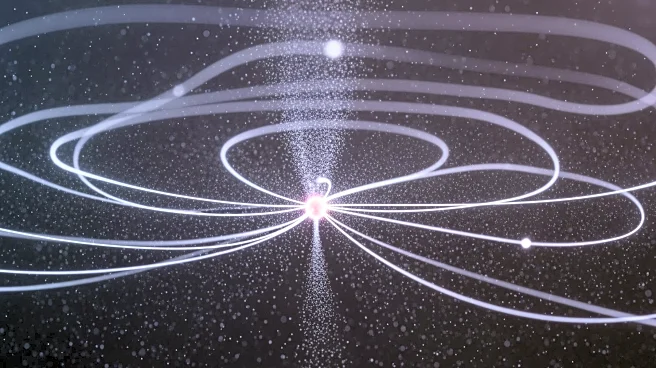
shows that magnetism can either accelerate or decelerate the growth of nanoparticles within the plasma. This occurs as magnetic fields cause electrons to move in spiral paths, affecting the entire plasma's dynamics and altering how particles gain electrical charge and grow. The study involved creating carbon nanoparticles by igniting a mixture of argon and acetylene gas, observing that magnetic fields shortened the growth period of these particles, resulting in smaller sizes. The findings have implications for both practical applications in electronics and surface coatings, as well as understanding natural plasmas in space.
Why It's Important?
The study's findings are significant for several reasons. Firstly, they offer potential advancements in the production of nanoparticles with specific properties, which could benefit industries such as electronics and quantum technologies. Secondly, the research provides insights into the behavior of natural plasmas found in space, such as those in planetary rings and the Sun's atmosphere. Understanding how magnetic fields influence plasma behavior could lead to new methods for manipulating materials at the nanoscale, potentially revolutionizing manufacturing processes. Additionally, the study enhances scientific knowledge of plasma physics, contributing to broader research in fields like astrophysics and materials science.