


What's Happening?
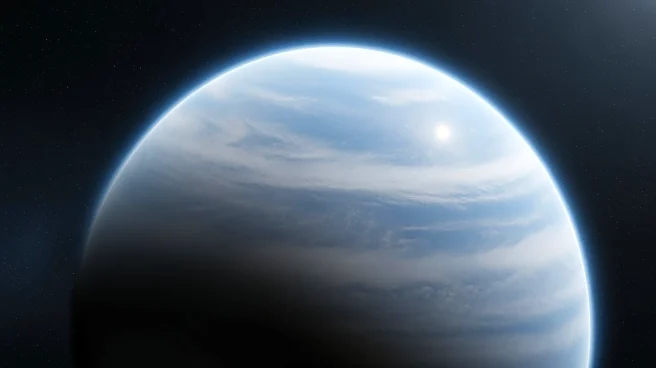
The James Webb Space Telescope (JWST) has encountered challenges in studying the exoplanet Kepler-51d due to an unusually dense haze surrounding the planet. This haze, the thickest ever detected, obscures the planet's atmospheric composition, making it difficult
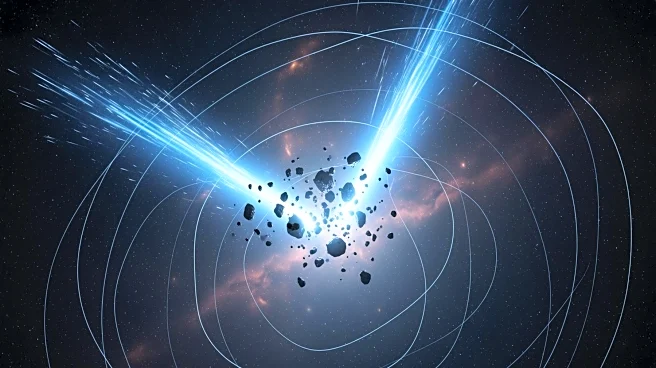
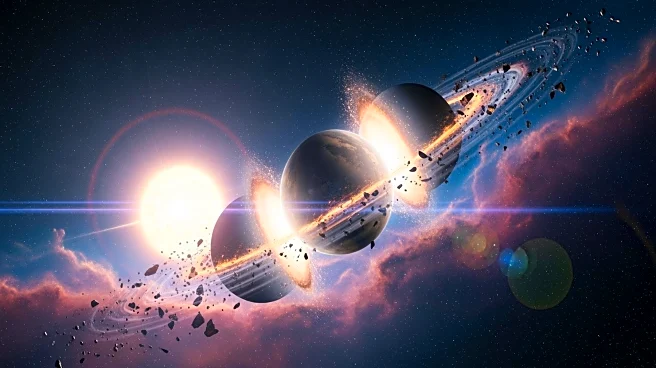
for researchers to determine its chemical makeup or formation history. Kepler-51d, part of a system located 2,615 light years away in the constellation Cygnus, is classified as a 'super-puff' planet due to its low density and large size relative to its mass. The planet's atmosphere is believed to consist largely of lightweight gases like hydrogen and helium. Despite the advanced capabilities of the JWST, which extends observation into longer infrared wavelengths, the haze has prevented clear atmospheric readings. Researchers are exploring the possibility of rings contributing to the observed data, though this remains speculative.
Why It's Important?
The findings from the JWST's observations of Kepler-51d challenge existing models of planet formation, particularly for gas giants. Typically, such planets form with dense cores that attract thick atmospheres, but Kepler-51d lacks a dense core and orbits closer to its star than expected for a gas giant. This anomaly raises questions about the processes that lead to the formation of such planets and suggests that our understanding of planetary systems may be incomplete. The study of Kepler-51d and similar exoplanets could provide insights into the diversity of planetary systems and the conditions that lead to their formation, potentially reshaping theories about the development of planets both within and outside our solar system.
What's Next?
Further observations are planned to better understand the atmospheric composition of Kepler-51d and other super-puff planets in the same system. Researchers aim to use the JWST's Mid Infrared Instrument to explore longer wavelengths that might penetrate the haze or detect potential ring materials. These efforts could clarify whether the haze is a common feature among super-puff planets or unique to Kepler-51d. The ongoing study of these planets will contribute to a broader understanding of planetary formation and the variety of planetary systems in the universe.