









What's Happening?
The Tilton Library in Deerfield, Massachusetts, has officially opened its newly renovated and expanded facility. The project, supported by a grant of over $4.4 million from the Massachusetts Board of Library Commissioners (MBLC) Massachusetts Public Library Construction
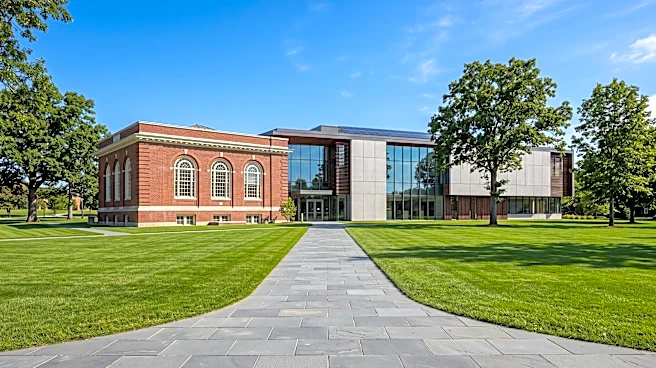
Program (MPLCP), involved restoring the original 1916 building, removing a 1997 addition, and constructing a new, fully accessible wing. This expansion has nearly tripled the library's footprint, growing from 4,366 to 12,784 square feet. The new design aims to complement the existing structure while providing modern amenities. Key additions include an expanded children's room, a dedicated space for teenagers, quiet study areas, small group activity rooms, a self-service business center, and a large community meeting room designed for use after library hours. The original building's restored space now features areas for crafts and making, and the reading room has been re-established for reading and conversation. The new addition also incorporates sustainable design elements, such as solar panels, making the library eligible for an MPLCP Green Library Incentive pending LEED Certification.
Why It's Important?
This significant investment in the Tilton Library reflects a broader commitment to public infrastructure and community resources in Deerfield, Massachusetts. The expansion addresses the needs of a growing population by providing enhanced services and spaces for all age groups, from children and teens to adults. The inclusion of a self-service business center and community meeting rooms highlights the library's evolving role as a central hub for education, collaboration, and economic development within the town. Furthermore, the emphasis on sustainable design, through the installation of solar panels and pursuit of LEED Certification, sets a precedent for environmentally conscious public projects. This initiative not only improves access to information and learning but also fosters a sense of community and supports local economic activity by offering resources for small businesses and remote workers. The project's success, partially funded by state grants, underscores the importance of state-level support for local library development and its impact on community well-being and future generations.
What's Next?
Following the grand opening, the Tilton Library will focus on integrating its new spaces and expanded services into the community. The eligibility for an MPLCP Green Library Incentive pending LEED Certification suggests an ongoing commitment to environmental standards, with the library likely pursuing the necessary steps to achieve this certification. The increased capacity and new facilities are expected to lead to a wider range of programs and events, catering to diverse community interests and needs. The success of this project may also serve as a model for other communities in Massachusetts considering similar library renovations or expansions, potentially encouraging further state funding for such initiatives through programs like the MPLCP. Local officials and library staff will likely monitor the utilization of the new spaces and gather community feedback to ensure the library continues to meet the evolving demands of Deerfield's residents.
Beyond the Headlines
The transformation of the Tilton Library goes beyond a simple building expansion; it represents a philosophical investment in the future of Deerfield. Senator Jo Comerford's remarks, emphasizing the town's decision to invest in 'future generations,' highlight the long-term vision behind the project. Libraries, traditionally seen as repositories of books, are increasingly becoming dynamic community centers that offer a wide array of services, from digital literacy training to collaborative workspaces. This expansion reflects a recognition of this evolving role, positioning the Tilton Library as a vital institution for civic engagement, lifelong learning, and social cohesion. The sustainable design elements also signal a growing awareness of environmental responsibility in public infrastructure, integrating ecological considerations with community development. This project underscores the enduring value of public libraries as democratic spaces that provide equitable access to resources and opportunities, fostering an informed and connected citizenry.