
What's Happening?
A team from the Bill & Melinda Gates Foundation has praised and sought information about an AI-powered drone technology developed by two young men from Mehsana, India. This indigenous technology, created
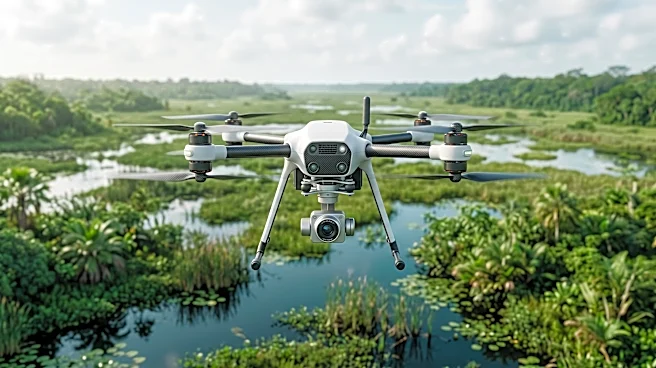
by Prime UAV, a company based in Mehsana, is designed to detect mosquito breeding hotspots, including those in inaccessible areas, to combat malaria. The drone, trained in entomology, can identify mosquito eggs and breeding sites within seconds, providing live updates to supervisors. This innovation addresses a significant challenge for ground teams, who often locate breeding sites only after mosquitoes have already developed. The technology has been successfully used to identify over 3,500 breeding sites in the Gandhinagar Municipal Corporation area between July and August, and has been appreciated by various municipal corporations in Gujarat and international NGOs.
Why It's Important?
The recognition from the Bill & Melinda Gates Foundation highlights the global significance of this AI drone technology in public health. Mosquito-borne diseases like malaria pose a major global health threat, and effective control measures are crucial. This Indian innovation offers a scalable and efficient solution to a long-standing problem, potentially revolutionizing mosquito control efforts worldwide. By rapidly identifying breeding sites, the technology can break the mosquito life cycle, which is often missed by traditional ground surveillance methods. The foundation's interest, particularly given its work in African countries and the U.S., suggests that this technology could be adopted internationally, leading to a significant reduction in mosquito-borne disease cases and saving countless lives. This also underscores the growing role of AI and drone technology in addressing critical public health challenges.
What's Next?
Following the interest from the Bill & Melinda Gates Foundation, the AI drone technology developed by Prime UAV could see broader international adoption and further development. The foundation's inquiry suggests potential partnerships or funding opportunities that could facilitate the expansion of this technology to other regions, including African countries and potentially the U.S., where mosquito-borne diseases remain a concern. The company, which has already achieved a 48% reduction in mosquito-borne disease cases in high-infection areas of Surat, plans to continuously add new features to its technology. This could lead to more sophisticated drone capabilities, improved data analysis, and more efficient insecticide spraying in hard-to-reach areas, further enhancing global efforts to eliminate malaria and other mosquito-borne illnesses.
Beyond the Headlines
This story goes beyond a simple technological advancement; it represents a paradigm shift in how public health challenges can be tackled through localized innovation. The success of these young Indian entrepreneurs in developing a solution that garners international attention from a major philanthropic entity like the Gates Foundation underscores the potential of grassroots innovation from developing nations. It also highlights the increasing convergence of technology, public health, and environmental management. The drone's ability to provide irrefutable evidence of breeding sites, as demonstrated by the incident with the school rooftop and the tire shop, introduces a new level of accountability and efficiency in public health interventions. This development could inspire similar AI-driven solutions for other environmental and health challenges globally, fostering a new era of tech-enabled public service.