




What's Happening?
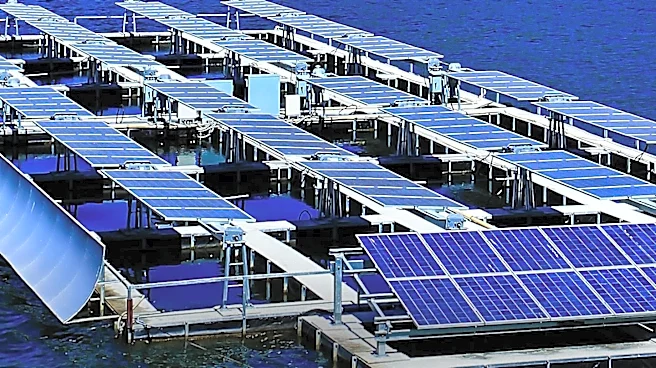
University of Arkansas researchers have installed a 70-kilowatt, 96-panel floating solar array on a rice irrigation reservoir in Stuttgart, Arkansas. This pilot project, covering about 0.1 acre of a 40-acre reservoir, aims to assess the viability of generating
electricity without converting agricultural land, reducing water loss from evaporation, and understanding maintenance requirements in a challenging environment. The project also includes 24 additional panels on the reservoir embankment. Michael Popp, an agricultural economist leading the initiative, seeks to gather data on operational costs, environmental impacts, and the interaction with local wildlife, particularly the hundreds of thousands of migratory mallards that winter in the area. The project's goals include creating synergy between utility companies, solar investors, farmers, and policymakers, while addressing the trade-off between solar development and agricultural land use.
Why It's Important?
This initiative holds significant importance for U.S. agriculture and renewable energy strategies. By utilizing irrigation reservoirs for solar panel placement, the project addresses the growing conflict between solar farm development and the preservation of prime agricultural land. Floating solar arrays require less space per megawatt compared to ground-mounted systems, making them a more land-efficient option. Furthermore, the panels shade the water, which is expected to reduce evaporation by 25% to 50%, a critical benefit for water-stressed farming regions. Saved water directly translates to economic savings for farmers, particularly in rice cultivation where irrigation is essential. If successful, this model could offer a new revenue stream for farmers with irrigation ponds and contribute to sustainable water management practices across the country, potentially influencing how America approaches solar energy integration in agricultural landscapes.
What's Next?
The immediate next step for the project is to collect comprehensive data on its performance, operational costs, and environmental impacts, especially concerning water evaporation rates and the behavior of migratory birds. Researchers will monitor how the mallards interact with the floating panels, as their reaction could significantly influence the adoption of such technology. The project will also analyze the economic viability for farmers and the broader agricultural sector. The findings from this pilot will inform future policy decisions and investment in floating solar technology on irrigation reservoirs. The University of Arkansas team is also analyzing survey data from Mid-South households and farmers regarding their willingness to pay to keep solar development off farmland, which will provide valuable insights into public perception and support for such innovative solutions.
Beyond the Headlines
Beyond the immediate benefits of electricity generation and water conservation, this project explores a novel approach to resource optimization and environmental coexistence. The integration of solar technology with agricultural water infrastructure represents a shift towards multi-functional land use, challenging traditional notions of how land and water resources are managed. The interaction with migratory birds introduces an ecological dimension, highlighting the need for renewable energy solutions to consider biodiversity and wildlife habitats. This experiment could pave the way for broader adoption of 'agrivoltaics' or 'aquavoltaics' in the U.S., where energy production is harmonized with agricultural and ecological systems. It also underscores the role of academic research in developing practical, sustainable solutions for complex challenges at the intersection of energy, agriculture, and environmental stewardship.