



What's Happening?
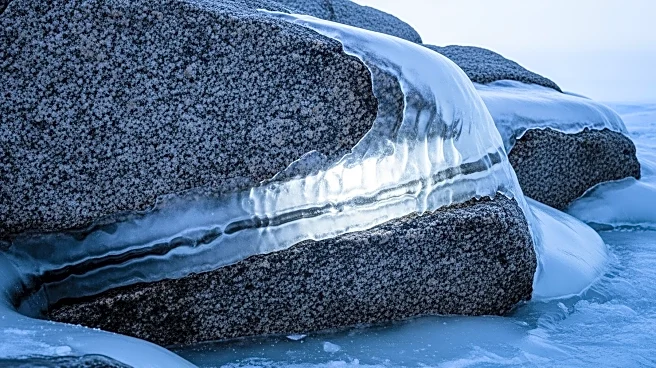
Researchers have identified bright pink boulders scattered across the peaks of West Antarctica's Hudson Mountains, leading to the discovery of a massive granite body buried beneath the ice. This geological curiosity is linked to a structure stretching
for tens of kilometers below the Pine Island Glacier. The boulders, classified as 'glacial erratics,' were transported by glaciers from their original location. The study, led by the British Antarctic Survey, used rock sampling and airborne geophysical surveys to trace the boulders' origins, revealing a large subglacial formation.
Why It's Important?
This discovery provides valuable insights into the geological history and ice movement in Antarctica. Understanding the origins and movements of these boulders helps scientists reconstruct past ice flow patterns, which is crucial for predicting future changes in the West Antarctic Ice Sheet. As environmental conditions shift, this knowledge can inform models that predict ice sheet behavior, contributing to global sea-level rise projections. The findings also highlight the potential for uncovering hidden geological features beneath ice sheets, which could have broader implications for understanding Earth's geological processes.
What's Next?
Further research is likely to focus on detailed mapping and analysis of the subglacial granite structure to better understand its formation and impact on ice dynamics. Scientists may conduct additional surveys to explore other hidden geological features in Antarctica. The study's findings could prompt international collaboration to monitor and model ice sheet changes, contributing to global climate change research. As the ice sheet's stability is crucial for sea-level predictions, ongoing research will be essential in informing climate policy and adaptation strategies.