







What's Happening?
Augmented Reality (AR) is increasingly being integrated into educational settings, offering new ways for students to learn through immersive experiences. Unlike Virtual Reality (VR), AR overlays digital content onto the real world, allowing students to interact
with 3D models and information while still observing their physical surroundings. Examples include Google Search's feature that enables users to view 3D models of objects, animals, and cultural heritage sites in their own space. This technology supports language and history immersion by allowing students to examine artifacts or models from different angles and provides camera-based translation tools for language learners. AR is also being used for STEM visualization, making abstract concepts like molecular shapes and anatomical systems easier to grasp through rotatable 3D models. Early prototypes are even exploring AR glasses for live captioning to aid deaf and hard-of-hearing students.
Why It's Important?
The integration of AR in education is significant because it addresses several limitations of traditional learning methods. By providing interactive 3D models and contextual information, AR enhances visualization, making complex subjects more accessible and engaging. This can lead to improved learning gains, particularly in STEM fields, as students can explore concepts that are otherwise invisible or too complex for flat diagrams. For language and history, AR offers a dynamic way to experience cultural heritage and practice language skills in real-world contexts. Furthermore, AR holds promise for accessibility, potentially making educational content more inclusive for students with disabilities. The ability to use existing devices like smartphones also lowers the barrier to entry for schools, making this technology more widely adoptable.
What's Next?
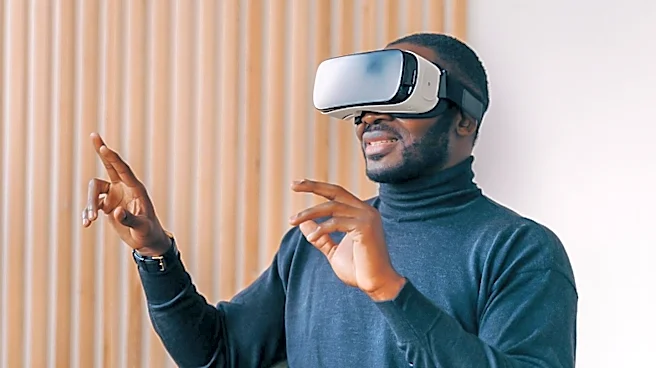
The field of AR in education is still evolving, with ongoing research and development. While phone-based AR is becoming more common, headset-based AR and specialized content libraries are also emerging. Future developments will likely focus on refining AR applications for various subjects, improving accessibility features, and integrating AR more seamlessly into classroom curricula. Teacher preparation and professional development will be crucial to effectively leverage these tools. As the technology matures, it is expected to offer more sophisticated and personalized learning experiences, potentially transforming how students interact with educational content and how educators deliver instruction. The market for AR/VR training is projected to reach $142 billion by 2031, indicating significant future growth and investment.
Beyond the Headlines
Beyond its immediate educational benefits, AR's rise in the classroom signals a broader shift in pedagogical approaches, moving towards more interactive, experiential, and personalized learning. It challenges the traditional model of passive information consumption, encouraging active engagement and critical thinking. The distinction between AR and VR also highlights a nuanced understanding of immersive technologies, where the choice of tool depends on the specific learning objective. This development raises questions about digital equity, as access to devices and high-quality AR content could create new disparities. Moreover, the emphasis on visualization and contextual learning through AR could reshape cognitive processes, fostering new ways of understanding and problem-solving in future generations.