




What's Happening?
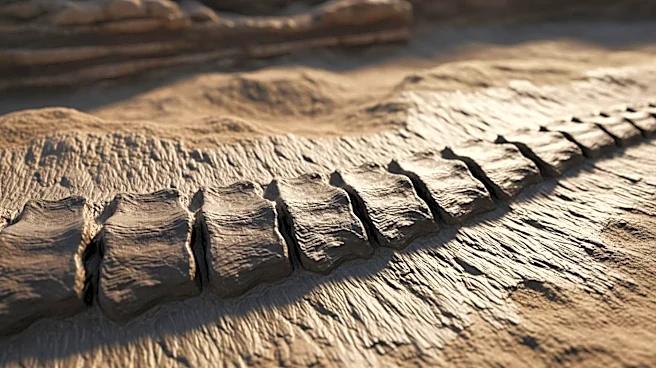
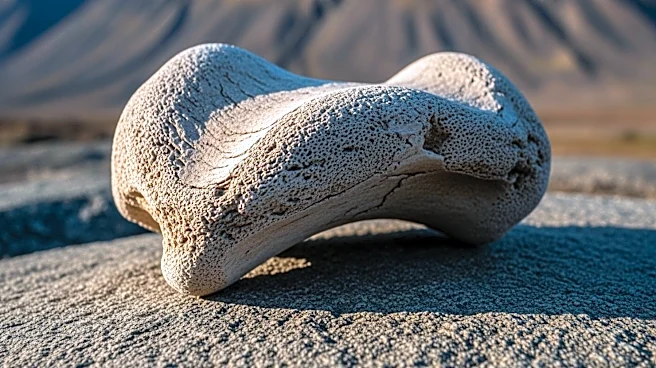
A recent study published in the Journal of Quaternary Science has revealed that fossils long thought to be woolly mammoth backbones, housed in an Alaskan museum for 70 years, are actually the remains of whales. The misidentification dates back to the 1950s
when archaeologist Otto Geist discovered the bones in Alaska's interior, a region known for megafauna fossils. Initially believed to be mammoth due to their size and location, the bones were stored at the University of Alaska's Museum of the North. However, recent investigations using radiocarbon dating and DNA testing have identified the fossils as belonging to two whale species: a minke whale and a North Pacific right whale. This discovery has raised questions about how these marine remains ended up so far inland, with theories suggesting either mislabeling of the discovery site or transportation by ancient peoples or scavengers.
Why It's Important?
This revelation is significant as it challenges previous assumptions about the distribution of ancient species and highlights the importance of accurate fossil identification. The misidentification underscores the potential for historical errors in paleontological records, which can impact our understanding of species' historical ranges and behaviors. For the scientific community, this case emphasizes the need for continual re-evaluation of existing collections with modern techniques. The findings also contribute to cetacean studies, providing new genetic data that could inform future research on whale evolution and migration patterns. Additionally, the incident serves as a reminder of the complexities involved in archaeological and paleontological research, where initial assumptions can lead to long-standing misconceptions.
What's Next?
Following this discovery, further investigations may be conducted to determine the exact origins of the whale fossils and to explore other potential misidentifications in museum collections. The University of Alaska's Museum of the North may undertake a review of its catalog to ensure the accuracy of its fossil identifications. This case may also prompt other institutions to re-examine their collections, potentially leading to more discoveries and corrections. The new genetic data from the whale fossils could be used in comparative studies to enhance understanding of ancient marine life and its interactions with human populations. Researchers may also explore the implications of these findings for understanding the historical ecology of the region.
Beyond the Headlines
The discovery of whale bones mislabeled as mammoth fossils highlights broader issues in the field of archaeology and paleontology, such as the challenges of accurately interpreting fossil evidence and the potential for human error in scientific research. It also raises questions about the movement and trade of ancient peoples, who may have transported marine remains inland for use as tools or other purposes. This case illustrates the evolving nature of scientific knowledge, where new technologies and methodologies can overturn long-held beliefs and lead to a more nuanced understanding of the past. The incident may also inspire discussions about the preservation and management of museum collections, emphasizing the need for ongoing research and verification.