



What's Happening?
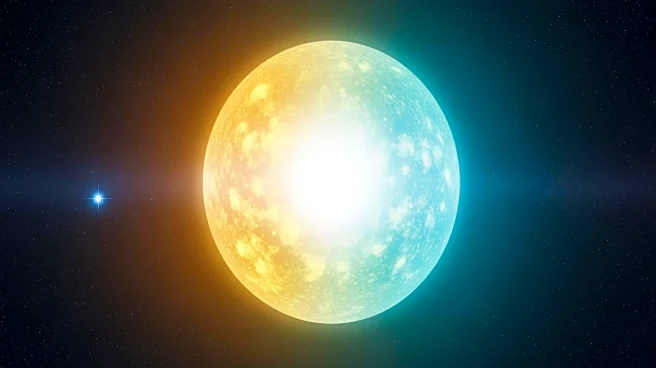
A recent study by astronomers, including astrophysicist Gregory Gilbert from the University of California Los Angeles, has highlighted the complexities in distinguishing between stars and planets, particularly focusing on brown dwarfs. Brown dwarfs are
celestial objects that are too massive to be considered planets but not massive enough to sustain hydrogen fusion like stars. The study examined 70 objects ranging from Jupiter-mass planets to brown dwarfs, aiming to find a clear demarcation between objects that form like stars and those that form like planets. However, the researchers found that the universe does not adhere to such clear-cut distinctions. The study revealed that the line between stars and planets is more of a continuum, with some brown dwarfs forming through processes similar to planets, such as core accretion, while others form through gravitational collapse, a process typical of star formation.
Why It's Important?
This study is significant as it challenges the traditional understanding of celestial object classification, which has implications for astrophysics and our understanding of the universe. The inability to clearly categorize these objects affects how scientists study planetary formation and star evolution. It also impacts the search for exoplanets and the understanding of their formation processes. The findings suggest that the processes leading to the formation of massive celestial bodies are more complex and intertwined than previously thought, which could lead to a reevaluation of existing models and theories in astronomy. This has broader implications for the study of the cosmos and could influence future research directions and methodologies.
What's Next?
The study suggests that further research is needed to explore the parameters that might define the formation processes of these celestial objects. Astronomers may need to examine a larger sample of objects or consider different combinations of parameters to find a clearer dividing line. Future studies could focus on the chemical composition of host stars and the orbital characteristics of these objects to gain more insights. The ongoing research could lead to new discoveries about the formation and evolution of celestial bodies, potentially reshaping our understanding of the universe.
Beyond the Headlines
The study raises questions about the classification systems used in astronomy and whether they adequately reflect the complexities of the universe. It highlights the need for more nuanced models that can accommodate the spectrum of celestial objects observed. This could lead to a shift in how astronomers approach the study of planetary and star formation, encouraging more interdisciplinary research and collaboration. The findings also underscore the importance of technological advancements in telescopes and data analysis tools, which are crucial for observing and understanding these distant objects.