





What's Happening?
The European Space Agency (ESA) and Japan Aerospace Exploration Agency (JAXA) have successfully powered on their Ramses planetary defense spacecraft for the first time. This event marks a significant milestone in the spacecraft's development, which is on a time-critical
schedule to rendezvous with the Apophis asteroid. The Core Module of Ramses, containing its main electronics, is currently being assembled at OHB Italia's Milan facility. Key units, including the On-Board Computer, Mass Memory Unit, Power Conditioning and Distribution Unit, and multiple Remote Terminal Units, have been integrated and linked via the spacecraft harness. This initial power-on allowed for the first integrated functional testing, verifying the performance of these interconnected systems. The Ramses mission is designed to reach space by spring 2028 to intercept the Apophis asteroid as it passes Earth on April 13, 2029, necessitating a rapid development timeline of less than three and a half years from contract signing to lift-off.
Why It's Important?
The successful activation of the Ramses spacecraft is crucial for advancing planetary defense capabilities. The mission aims to study the Apophis asteroid, which will make a close approach to Earth in 2029. Understanding such near-Earth objects is vital for developing strategies to mitigate potential impact threats. This collaboration between ESA and JAXA highlights international cooperation in space exploration and defense, pooling resources and expertise to address global challenges. The rapid development schedule for Ramses underscores the urgency and importance placed on this mission, demonstrating a commitment to proactive planetary protection. The data gathered by Ramses will provide invaluable insights into asteroid composition, trajectory, and behavior, which are essential for future asteroid deflection or mitigation efforts, thereby safeguarding Earth from potential cosmic impacts.
What's Next?
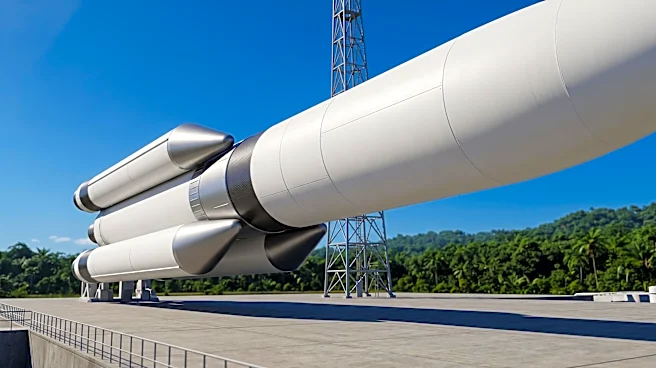
Following this initial power-on, the Ramses spacecraft will undergo comprehensive integrated system testing. This phase will involve reproducing all conditions the spacecraft will experience during launch and in-space operations, including challenging thermal vacuum tests and mission simulation tests. The spacecraft's Core Module and Propulsion Module, currently being assembled separately, will be mated together next spring at ESA's ESTEC Test Centre in Noordwijk, the Netherlands, marking the beginning of its pre-flight testing phase. The ESA-JAXA Ramses mission, along with its two accompanying CubeSats, is scheduled to be launched on a Japanese H-3 rocket in spring 2028. The successful completion of these rigorous testing phases is critical to ensure the spacecraft's readiness for its rendezvous with the Apophis asteroid in 2029.
Beyond the Headlines
The Ramses mission represents a significant step in humanity's ability to understand and potentially defend against asteroid threats. Beyond the immediate goal of studying Apophis, the technologies and operational procedures developed for Ramses could lay the groundwork for future missions involving asteroid reconnaissance, characterization, and even resource utilization. The mission also highlights the growing importance of international partnerships in addressing complex space challenges that transcend national borders. The insights gained from Ramses will not only enhance scientific knowledge about asteroids but also contribute to the long-term security and sustainability of human civilization by improving our capacity to predict and respond to potential cosmic hazards. This proactive approach to planetary defense reflects a maturing understanding of our place in the solar system and the need to protect our home planet.