



What's Happening?
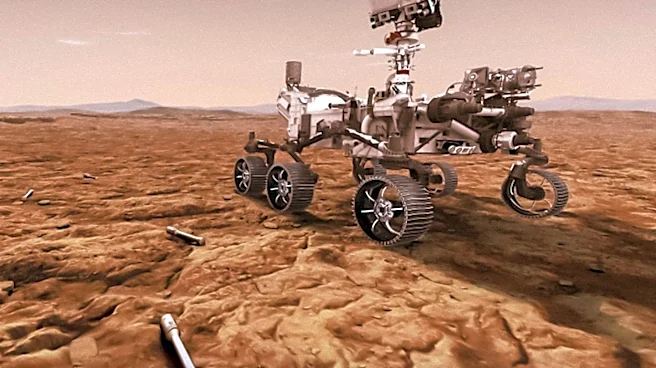
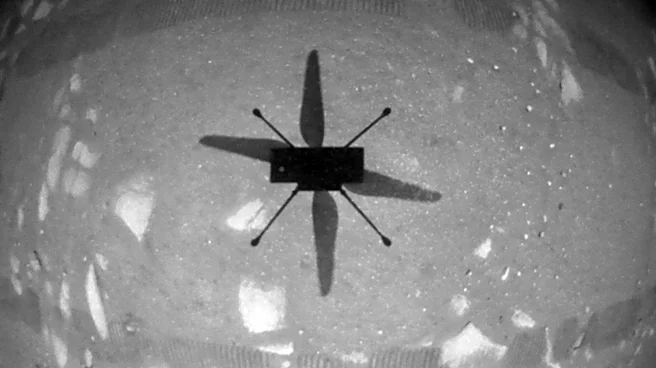
Elise Rimsa, a Marquette University alumna (Arts '18), is working as an instrument operator and data operations engineer at NASA's Jet Propulsion Laboratory (JPL). Her responsibilities include commanding the engineering cameras aboard the Mars 2020 Perseverance
rover, which is approximately 140 million miles away on Mars. The imaging system is crucial for the rover's operations, including navigation, hazard avoidance, and sample collection on the Martian surface. The images captured by Rimsa and her team provide vital information for rover planners and scientists to determine the rover's next actions. The mission's primary goal is to search for signs of ancient life on Mars and collect rock and soil samples for potential return to Earth for detailed study. Rimsa emphasizes that space exploration is a collaborative effort involving hundreds of people at JPL.
Why It's Important?
Elise Rimsa's work on the Mars 2020 Perseverance rover highlights the critical role of U.S. scientists and engineers in advancing space exploration and scientific discovery. The Perseverance mission represents a significant investment in understanding the potential for life beyond Earth and provides invaluable data about Mars's geology and atmosphere. The images and data collected by the rover contribute to a global scientific understanding, informing future missions and potentially paving the way for human exploration of Mars. This work also inspires the next generation of STEM professionals, as evidenced by Rimsa's own journey from a childhood interest in space to a pivotal role at JPL. The development of aerospace engineering programs, such as the new concentration at Marquette's Opus College of Engineering, is crucial for training the workforce needed to sustain and expand these ambitious space endeavors, ensuring the U.S. remains at the forefront of space exploration.
What's Next?
The Mars 2020 Perseverance mission will continue to collect and analyze data from the Martian surface, with ongoing efforts to identify and store samples for a potential future mission to retrieve them and bring them back to Earth. This sample return mission would mark a monumental achievement in planetary science, offering unprecedented opportunities for detailed analysis of Martian materials. The insights gained from Perseverance's operations will also inform the design and execution of future robotic and human missions to Mars. The growing public engagement and excitement around space exploration, fueled by missions like Artemis II and the Perseverance rover, are expected to encourage more students to pursue careers in aerospace engineering and related fields, ensuring a continuous pipeline of talent for future space endeavors.
Beyond the Headlines
The work of individuals like Elise Rimsa underscores the profound human drive for exploration and knowledge. Beyond the scientific objectives, missions like Perseverance contribute to a broader cultural narrative about humanity's place in the universe and our capacity for innovation. The breathtaking images and groundbreaking discoveries from Mars not only advance scientific understanding but also captivate the public imagination, fostering a sense of wonder and inspiring future generations. The collaborative nature of space exploration, involving hundreds of experts, also highlights the importance of teamwork and interdisciplinary approaches to solving complex challenges. This continuous push to explore new frontiers reflects a fundamental aspect of human curiosity and our desire to push the boundaries of what is known, with long-term implications for technological advancement and our understanding of life itself.