



What's Happening?
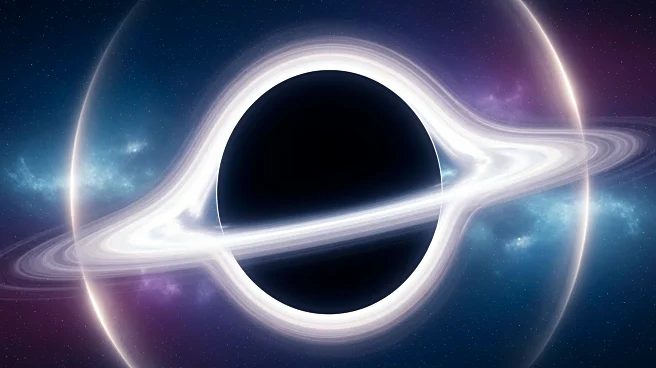
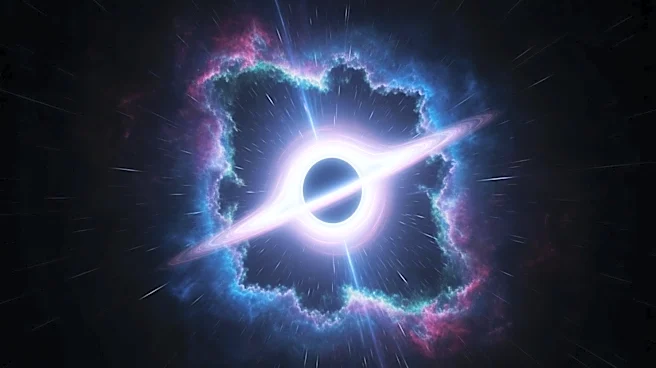
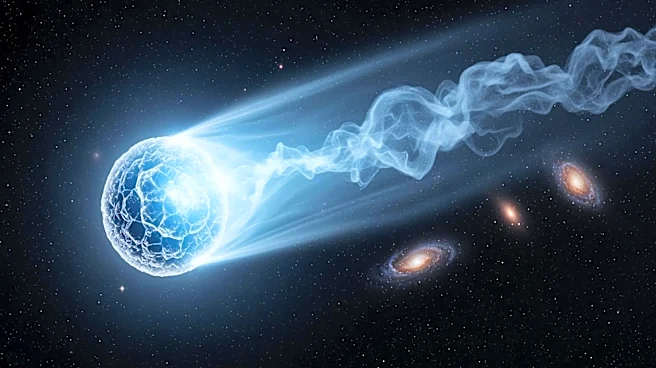
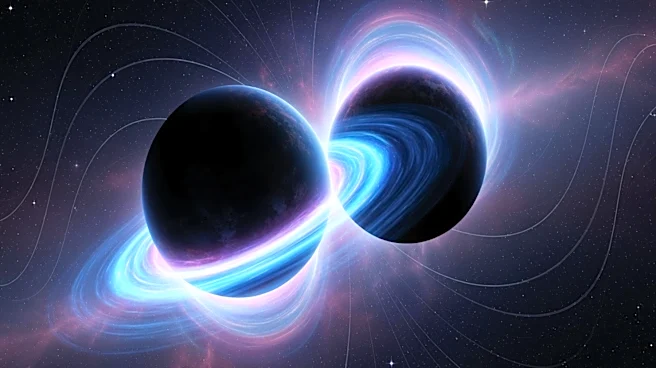
A team of physicists at the University of Portsmouth has proposed a theory suggesting that the universe was created by a massive bounce from an ancient black hole, challenging the traditional Big Bang model. This theory, known as the Black Hole Universe
theory, posits that the cosmos did not emerge from an explosion of matter but rather rebounded like a basketball from something already in existence. Originally pitched by Indian physicist Raj Kumar Pathria in the 1970s, the theory has gained traction with recent data from the James Webb Space Telescope. Observations of a spin imbalance in ancient galaxies support the idea that the universe was born spinning, hurled outward from a rotating black hole.
Why It's Important?
The Black Hole Universe theory offers a radical alternative to the Big Bang model, potentially reshaping our understanding of cosmic origins. If proven, it could alter fundamental concepts in cosmology and physics, impacting theories about the universe's expansion and the nature of black holes. This could lead to new insights into the universe's structure and the forces governing it, influencing future research and technological advancements in space exploration and astrophysics.
What's Next?
Further research and observations are needed to validate the Black Hole Universe theory. Scientists will continue to analyze data from the James Webb Space Telescope and other astronomical instruments to seek evidence supporting this model. The theory's acceptance could prompt a reevaluation of existing cosmological models and inspire new lines of inquiry into the universe's origins and evolution.
Beyond the Headlines
The implications of the Black Hole Universe theory extend beyond scientific circles, potentially influencing philosophical and cultural perspectives on the universe's creation. It challenges long-held beliefs about the Big Bang, prompting discussions about the nature of existence and the universe's ultimate fate. This could lead to broader debates about the intersection of science and philosophy in understanding cosmic phenomena.