



What's Happening?
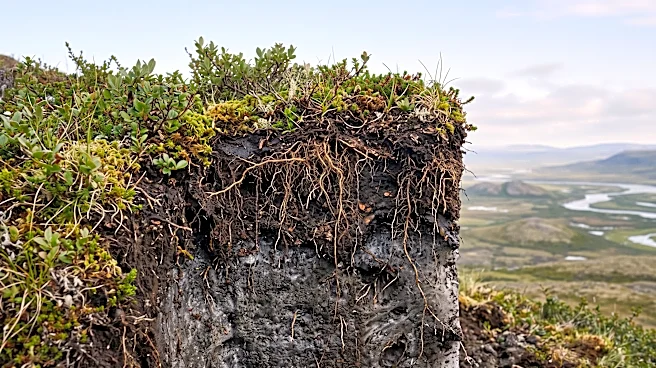
A new research review has highlighted the critical role of plant roots in Arctic tundra ecosystems in determining whether soil acts as a carbon source or sink. Published on October 31, 2026, this comprehensive study, led by Amherst College with contributions
from eight other research organizations including The James Hutton Institute and Umeå University, investigates how rising temperatures alter plant root growth patterns. These changes, in turn, affect soil microbes that release carbon dioxide and methane. The study integrates data to analyze root productivity and depth shifts, aiming to better map these interactions and predict the risk of runaway climate change originating from thawing permafrost. Arctic permafrost currently stores an estimated 1,460 to 1,600 billion tons of organic carbon, making these subterranean processes crucial for global climate models.
Why It's Important?
Understanding these subterranean processes is essential for improving the accuracy of global climate models, which are vital for guiding policy decisions. The prevailing hypothesis that Arctic tundra is a simple carbon sink is being refined by these findings, suggesting that biological shifts beneath the soil could fundamentally alter the global climate trajectory. If Arctic ecosystems release trapped greenhouse gases due to permafrost thawing, it could significantly exacerbate climate change. Conversely, if they sequester carbon, they could help mitigate it. More reliable predictions from these refined models will enable policymakers to better estimate the potential risks of environmental changes to infrastructure and local ecosystems, impacting U.S. industries, public policy, and economic stakeholders. The stability of the Arctic climate, therefore, depends as much on what happens beneath the soil as in the atmosphere.
What's Next?
The scientific community plans to continue coordinating Arctic research efforts, with the 5th International Polar Year scheduled for 2032-2033. This ongoing research will further refine understanding of the complex relationship between plant growth, microbes, and permafrost thawing. The findings from this review will likely prompt adjustments in climate models used by international bodies and national governments, including the U.S., to forecast future climate scenarios. This could lead to updated environmental policies, investment in new research technologies, and strategies for mitigating the impact of permafrost thaw. The focus will be on identifying root-level drivers to improve the accuracy of climate change forecasts and inform global policy decisions regarding carbon emissions and environmental protection.
Beyond the Headlines
The study's findings underscore a deeper implication: the interconnectedness of seemingly isolated ecological processes with global climate stability. The Arctic, often perceived as a distant and pristine wilderness, is revealed as a critical component of the Earth's climate system, with its subterranean dynamics having far-reaching consequences. This highlights the ethical responsibility of global communities, including the U.S., to invest in comprehensive Arctic research and implement policies that address climate change holistically. The risk of 'digital inequality' between Arctic and other regions, as noted by the Northern Forum, also suggests that technological advancements, such as AI, must be leveraged responsibly to support scientific understanding and sustainable development in these vulnerable areas. The long-term shift could be towards a more integrated approach to climate science, recognizing the intricate feedback loops within ecosystems and their profound impact on the planet.