
What's Happening?
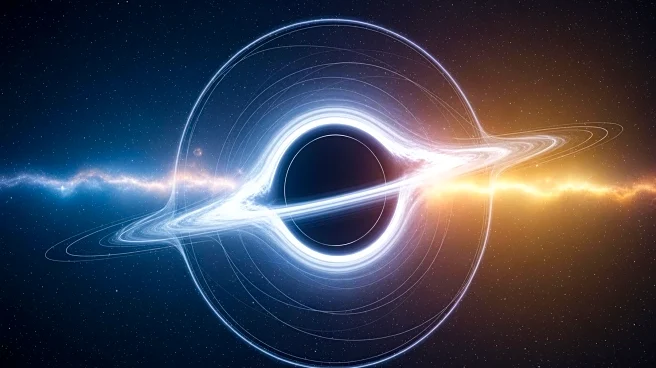
Astronomers have observed a phenomenon known as Lense-Thirring precession, or frame-dragging, near a spinning black hole, confirming a prediction made by Einstein over a century ago. This discovery was
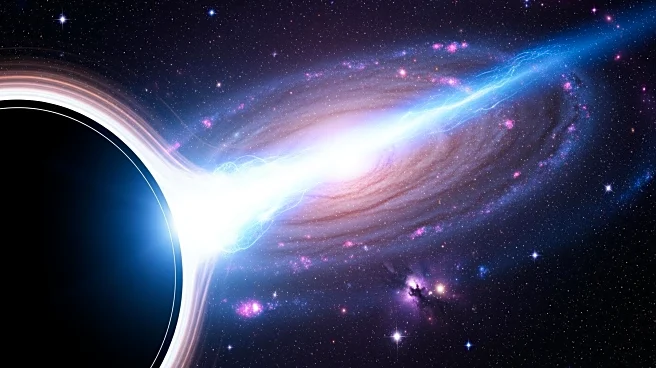
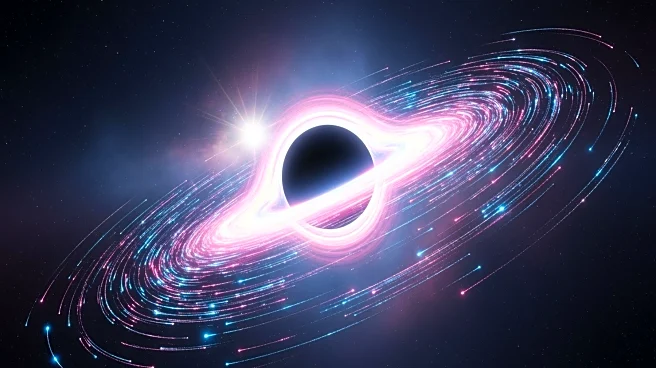
made during a tidal disruption event (TDE) where a star was destroyed after coming too close to a supermassive black hole. The debris from the star formed a rapidly rotating disk around the black hole, and powerful jets of material were launched outward. By analyzing X-ray and radio signals, scientists found that both the disk and the jet were wobbling together, repeating every 20 days. This coordinated motion provided a clear signature of the spacetime twisting effect. The research, led by the National Astronomical Observatories at the Chinese Academy of Sciences with support from Cardiff University, offers new insights into black hole spin and the nature of TDEs.
Why It's Important?
This observation is significant as it provides the most compelling evidence yet of Lense-Thirring precession, a key prediction of general relativity. It not only confirms Einstein's theory but also enhances our understanding of how black holes interact with their surroundings. The ability to detect and analyze such phenomena offers scientists a new method for probing black holes, potentially leading to breakthroughs in understanding the mechanics of black hole spin and the behavior of matter in extreme gravitational fields. This could have broader implications for astrophysics, as it opens up new avenues for exploring the universe's most enigmatic objects.
What's Next?
The confirmation of frame-dragging effects around black holes could lead to further studies aimed at understanding the detailed mechanics of black hole interactions. Researchers may focus on observing more tidal disruption events to gather additional data, which could refine models of black hole behavior and their impact on surrounding matter. This could also inspire new technological advancements in telescope and sensor technology to better capture and analyze such cosmic events.
Beyond the Headlines
The discovery highlights the intricate dance between theory and observation in astrophysics. It underscores the importance of continued investment in space observatories and international collaboration in scientific research. The findings also remind us of the vastness and complexity of the universe, encouraging a deeper appreciation for the fundamental forces that govern cosmic phenomena.