


What's Happening?
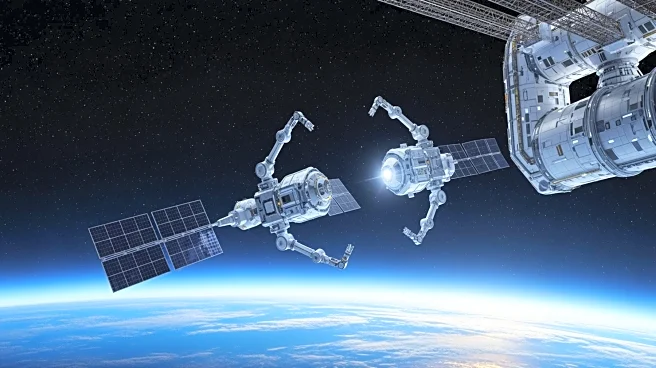
Impulse Space and Starfish Space have successfully completed a significant mission named Remora, which involved two commercial spacecraft performing a surprise rendezvous in Earth orbit. The mission demonstrated advanced autonomous rendezvous and proximity
operations (RPO) technology. A Mira spacecraft, equipped with Starfish's navigation software, approached another Mira spacecraft within 4,100 feet, showcasing the potential for future satellite servicing missions. The mission was developed in less than a year and involved the use of Starfish's Cetacean and Cephalopod software on a peripheral flight computer. The Mira spacecraft was launched in January 2025 on SpaceX's Transporter 12 rideshare mission, which carried 131 payloads to low Earth orbit.
Why It's Important?
The successful execution of the Remora mission marks a significant advancement in the field of satellite servicing, which could revolutionize how satellites are maintained and operated in space. The ability to autonomously rendezvous and perform proximity operations opens up possibilities for satellite inspection, refueling, repair, and even de-orbiting of non-functional satellites. This technology could lead to more sustainable space operations by extending the life of satellites and reducing space debris. The collaboration between Impulse Space and Starfish Space highlights the growing role of private companies in advancing space technology and operations, potentially reducing costs and increasing the efficiency of space missions.
What's Next?
Following the success of the Remora mission, Starfish Space plans to move forward with the launch of its Otter vehicle, which is designed to provide a range of satellite servicing functions. The Otter is expected to launch next year and will build on the capabilities demonstrated by the Remora mission. The continued development and deployment of such technologies could lead to more frequent and complex satellite servicing missions, further integrating private companies into the space industry and potentially leading to new business models and opportunities in satellite operations.