
What's Happening?
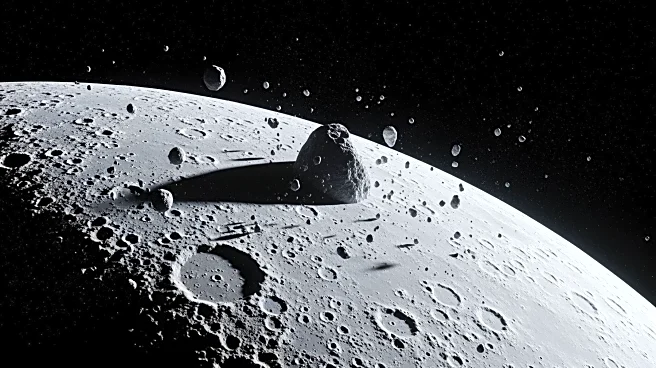
A new study proposes that Mars's smaller moon, Deimos, may have been reshaped by a sesquinary catastrophe, where debris from the moon itself caused its fragmentation and reformation. This hypothesis suggests
that Deimos's current smooth surface and circular orbit resulted from a process where debris from the moon's surface re-impacted it, leading to its current form. The study, conducted by researchers from Purdue University and the SETI Institute, uses computer models to simulate the impact of debris on Deimos, supporting the idea that the moon's orbit and surface characteristics are the result of this unique process.
Why It's Important?
Understanding the formation and evolution of Deimos provides insights into the history of the Martian system and the processes that shape celestial bodies. The study's findings challenge previous assumptions about Deimos's origin and suggest that similar processes could occur on other moons or planets. This research contributes to the broader understanding of planetary formation and the dynamic interactions between celestial bodies. The upcoming Martian Moon eXploration (MMX) mission by Japan, which will observe Deimos, could provide further evidence to support or refute this hypothesis, enhancing our knowledge of the Martian moons.
What's Next?
The Martian Moon eXploration (MMX) mission, set to observe Deimos, may provide crucial data to test the sesquinary catastrophe hypothesis. The mission's observations could reveal more about Deimos's surface composition and geological features, offering insights into its formation history. If the hypothesis is confirmed, it could lead to a reevaluation of the processes that shape moons and other celestial bodies. The findings could also influence future missions and research focused on understanding the dynamics of planetary systems and the role of debris in shaping celestial bodies.