






What's Happening?
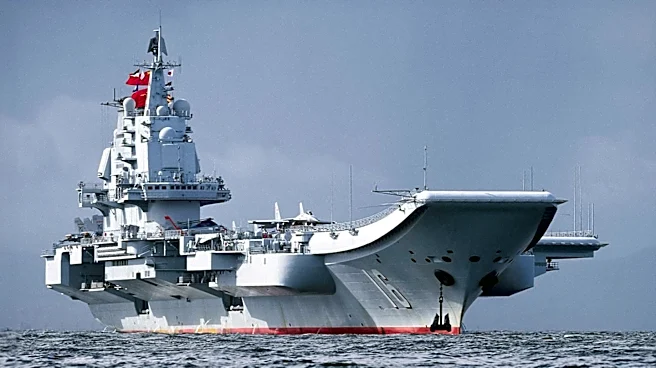
China's newest and most advanced aircraft carrier, the Fujian, recently sailed through the Taiwan Strait and into the South China Sea as part of its ongoing sea trials. The Chinese navy issued a statement on Friday, clarifying that this cross-regional
trial and training exercise is a routine part of the carrier's construction process and is not directed at any specific target. The Fujian, which was first unveiled in 2022, began its sea trials last year and has not yet formally entered service. Japan's defense ministry reported on Thursday that the Fujian entered the East China Sea, sailing southwest towards Taiwan, accompanied by two Chinese missile destroyers. Taiwan's defense ministry has been actively monitoring the situation using joint intelligence surveillance and has implemented appropriate measures in response. This transit occurs amidst increased military activity in the region, including ongoing exercises by U.S. Marines and Japanese counterparts on Okinawa, featuring advanced anti-ship weapons.
Why It's Important?
The transit of China's advanced aircraft carrier through the Taiwan Strait is significant due to the sensitive geopolitical context of the waterway. China considers the Taiwan Strait its territorial waters, a claim disputed by Taiwan, the United States, and many of its allies, who assert it is an international waterway. This movement by the Fujian, even if described as routine, underscores China's growing naval capabilities and its assertion of sovereignty in the region. The presence of the Fujian, designed to host a larger and wider range of aircraft, including stealth jet fighters, represents a substantial upgrade to China's power projection capabilities. Regional security analysts are closely observing these trials to assess how effectively the Chinese navy can coordinate full-blown carrier operations with escort ships and submarines. The increased military presence and exercises in the area, including those by U.S. and Japanese forces, highlight the escalating tensions and the strategic importance of the Taiwan Strait for international maritime security and trade.
What's Next?
The Fujian aircraft carrier is expected to continue its sea trials, which are a crucial phase before its formal commissioning into service. These trials will likely involve further testing of its systems, including its electro-magnetic catapults and the integration of various aircraft. Regional military observers will continue to monitor the carrier's movements and performance to gauge China's progress in developing its blue-water navy capabilities. Taiwan's defense ministry will maintain its heightened state of surveillance and readiness, adapting its measures as necessary in response to Chinese naval activities. The ongoing military exercises by the U.S. and Japan in the vicinity, scheduled to run until September 25, indicate a continued focus on regional security and deterrence. Future transits and exercises by the Fujian will likely be met with similar scrutiny and could influence the strategic calculus of nations in the Indo-Pacific, potentially leading to further adjustments in defense postures and alliances.
Beyond the Headlines
The Fujian's transit through the Taiwan Strait, while framed as routine, carries deeper implications for regional power dynamics and international maritime law. China's assertion of the Taiwan Strait as territorial waters challenges the principle of international waterways, which is crucial for global trade and freedom of navigation. This move could set precedents for how other contested maritime areas are treated, potentially impacting shipping routes and international commerce. The development and deployment of advanced aircraft carriers like the Fujian signal China's long-term ambition to project power far beyond its immediate coastline, shifting the balance of naval power in the Indo-Pacific. This technological advancement also raises questions about the future of naval warfare and the strategies required to counter such capabilities. The ongoing monitoring by Taiwan and its allies underscores the delicate balance of deterrence and the potential for miscalculation in a region already fraught with historical and political tensions.