



What's Happening?
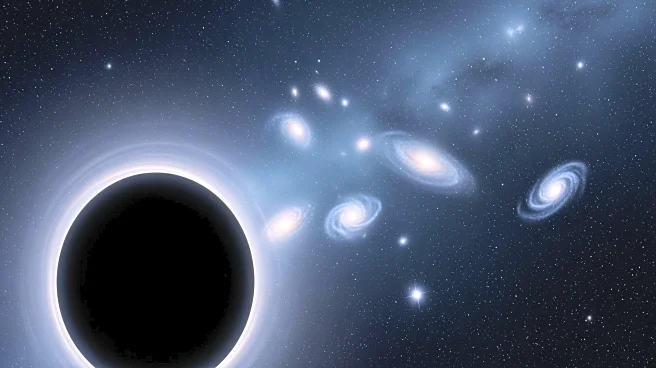
NASA's Chandra X-ray Observatory has conducted a study revealing that smaller galaxies are less likely to contain supermassive black holes compared to their larger counterparts. The research, which analyzed data from over 1,600 galaxies, found that only
about 30% of dwarf galaxies have supermassive black holes. This contrasts with larger galaxies, where over 90% contain these massive entities. The study utilized X-ray signatures to identify the presence of black holes, noting that smaller galaxies often lack the bright X-ray sources indicative of such black holes. The findings suggest that the formation of supermassive black holes may be less common in smaller galaxies, potentially due to differences in the amount of gas available for accretion.
Why It's Important?
This discovery challenges the prevailing notion that supermassive black holes are ubiquitous in all galaxies, providing new insights into galaxy formation and evolution. Understanding the distribution of black holes across different galaxy sizes can inform theories about their origins, such as whether they form from direct collapse of gas clouds or from smaller black holes. The findings also have implications for future gravitational wave detections, as fewer black holes in dwarf galaxies could mean fewer black hole mergers. This research could guide future astronomical studies and the development of new telescopes aimed at exploring these cosmic phenomena.
What's Next?
The study's results may prompt further investigations into the mechanisms behind black hole formation in galaxies of varying sizes. Researchers might focus on identifying the conditions that lead to the presence or absence of supermassive black holes in smaller galaxies. Additionally, future telescopes and instruments could be designed to detect fainter X-ray emissions, potentially uncovering more black holes in dwarf galaxies. This ongoing research could refine our understanding of the universe's structure and the role of black holes in galaxy dynamics.