
What's Happening?
Recent satellite imagery has revealed the deployment of Chinese bombers and other military aircraft to the Hotan airbase in western China. This move coincides with India's 'Exercise Trishul 2025', a significant
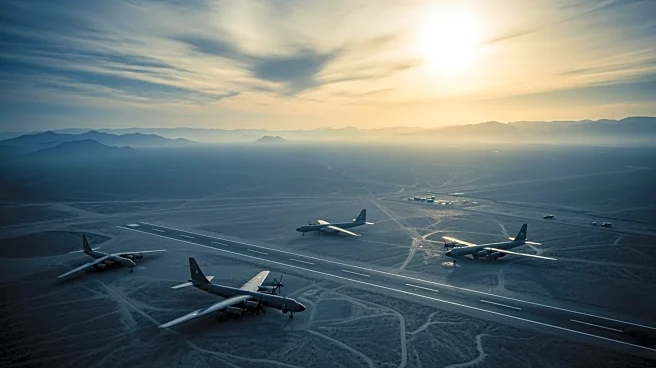
military exercise. The imagery, captured on November 7, 2025, shows four Xi'an H-6 bombers stationed at the Hotan civil-military airport, located approximately 230 kilometers from the Indian border. Alongside these bombers, the deployment includes two airborne early warning and control platforms, 18 Flanker series fighters, 12 Chengdu J-20 stealth fighters, and four Xi'an Y-20-series strategic transports. This marks the second deployment of J-20 fighters to Hotan in 2025 and the first confirmed deployment of H-6 bombers to this location. Historically, H-6 bombers have been deployed to regional airbases during periods of heightened tension, such as during the 2020 India-China border crisis.
Why It's Important?
The deployment of Chinese military aircraft to Hotan amid Indian military exercises underscores the ongoing strategic competition and tension between China and India. This move could be perceived as a show of strength by China, potentially escalating military tensions in the region. The presence of advanced aircraft like the J-20 stealth fighters and H-6 bombers near the Indian border may be seen as a direct response to India's military activities, signaling China's readiness to counter any perceived threats. Such deployments can impact regional stability, influencing diplomatic relations and defense strategies among neighboring countries. The situation also highlights the broader geopolitical dynamics in Asia, where military posturing and exercises are often used as tools of influence and deterrence.
What's Next?
The deployment of Chinese bombers to Hotan is likely to prompt a response from India, which may include increased military readiness or diplomatic engagements to address the perceived threat. Regional stakeholders, including countries like the United States and Japan, may also monitor the situation closely, given their strategic interests in maintaining stability in Asia. Future military exercises or deployments by either China or India could further influence the regional security landscape. Diplomatic channels may be utilized to de-escalate tensions, but the potential for miscalculation remains a concern. Observers will be watching for any changes in military posture or rhetoric from both sides in the coming weeks.
Beyond the Headlines
The deployment of military assets in response to exercises highlights the complex interplay of military strategy and diplomacy in Asia. It raises questions about the effectiveness of military deterrence and the risks of escalation in a region with multiple unresolved territorial disputes. The situation also reflects the broader trend of military modernization and strategic competition among major powers in Asia, which could have long-term implications for regional security architectures and alliances.