




What's Happening?
NASA is preparing for its Dragonfly mission, set to launch in 2028, which aims to explore Titan, Saturn's largest moon. Titan is unique in the solar system for having liquid methane and ethane on its surface, forming rivers, lakes, and seas. This hydrological
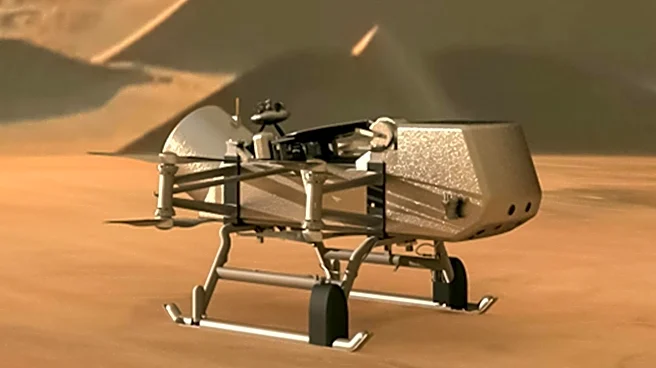
cycle is similar to Earth's water cycle but operates with different materials and under much colder conditions. The Cassini-Huygens mission previously mapped Titan's surface, revealing its complex landscape. The upcoming Dragonfly mission will use a nuclear-powered rotorcraft to fly across Titan's surface, studying its chemistry and geology in detail.
Why It's Important?
The Dragonfly mission is significant as it will provide unprecedented insights into Titan's environment, which is considered one of the most Earth-like bodies in the solar system. Understanding Titan's methane cycle could offer clues about the potential for life in extreme conditions and the processes that shape planetary bodies. The mission also represents a technological leap, as Dragonfly will be the first rotorcraft to explore another world, potentially paving the way for future aerial exploration of other celestial bodies.
What's Next?
Following its launch in 2028, Dragonfly is expected to reach Titan by the mid-2030s. Once there, it will conduct a series of flights to various locations, analyzing surface samples and atmospheric conditions. The data collected will help scientists understand Titan's complex chemistry and assess its habitability. The mission's findings could influence future exploration strategies and the search for life beyond Earth.
Beyond the Headlines
Titan's exploration raises questions about the potential for life in environments vastly different from Earth. The presence of complex organic molecules and a dense atmosphere makes Titan a prime candidate for studying prebiotic chemistry. The mission also highlights the challenges and innovations in space exploration, as engineers develop new technologies to operate in Titan's harsh conditions.