



What's Happening?
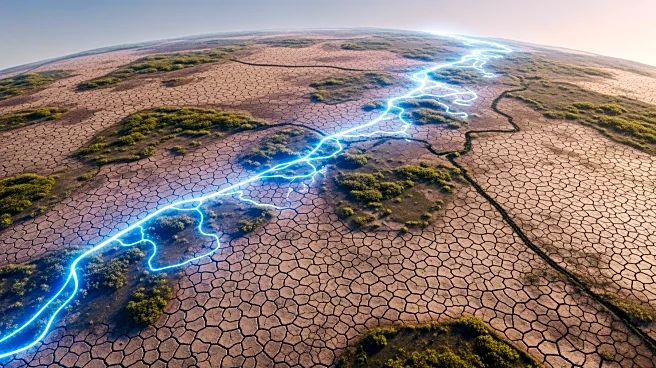
Recent satellite data from NASA's GRACE and GRACE-Follow On missions have highlighted a significant decline in global groundwater levels, with a notable impact on regions such as California's Central Valley. The data indicates that since 2014, approximately
1,200 cubic kilometers of terrestrial freshwater have been lost, a volume comparable to two and a half times that of Lake Erie. This depletion is attributed to factors like irrigation, climate change, and urban expansion. The satellites detect changes in Earth's gravitational field, which vary as aquifers lose water. This method has revealed that groundwater depletion is not just a regional issue but a global concern, affecting heavily irrigated and drought-prone areas worldwide.
Why It's Important?
The depletion of groundwater has profound implications for agriculture and urban water supply, especially during droughts when surface water sources are insufficient. As aquifers are drained faster than they can naturally recharge, the risk of agricultural failure and ecosystem stress increases. This situation creates a feedback loop where reduced rainfall leads to more groundwater pumping, further depleting aquifers. The findings underscore the urgent need for improved water management policies and practices to ensure sustainable water use and mitigate the risks associated with declining groundwater levels.
What's Next?
The ongoing monitoring by NASA's satellites will continue to provide critical data on groundwater levels, informing policymakers and stakeholders about the severity of the issue. There is a pressing need for international cooperation to develop strategies that address the root causes of groundwater depletion, such as inefficient irrigation practices and climate change. Additionally, regions heavily reliant on groundwater may need to explore alternative water sources or implement conservation measures to prevent further depletion.
Beyond the Headlines
The subtle nature of groundwater depletion, often unnoticed until it reaches critical levels, poses a challenge for public awareness and policy action. The reliance on aquifers as a backup during dry periods highlights the vulnerability of current water management systems. Long-term solutions may require significant changes in agricultural practices, urban planning, and climate adaptation strategies to ensure water security for future generations.