






What's Happening?
Researchers are advancing mid-infrared (MIR) frequency metrology by combining ultracold molecules with quantum cascade lasers (QCLs). Unlike microwave and optical domains, MIR metrology has not fully leveraged the long coherence times and precise control
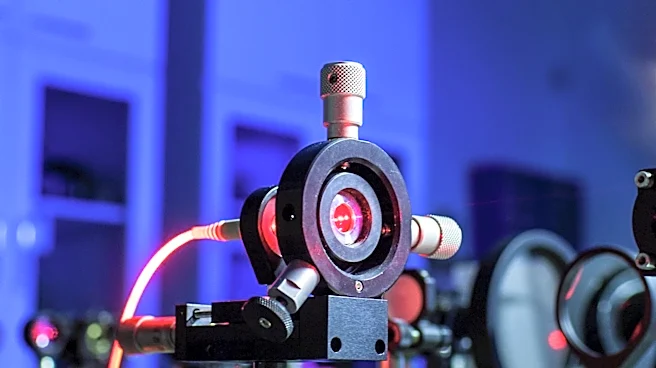
offered by ultracold particles. The study utilizes a QCL operating at 17.5 THz to drive ro-vibrational transitions in ultracold calcium monofluoride molecules. The laser's linewidth is narrowed to 15 kHz by locking it to a custom MIR ring cavity, which is then stabilized by an ultrastable laser. This setup allows for vibrational spectroscopy of ultracold molecules, demonstrating a significant step towards improving MIR frequency standards. The research highlights the potential for enhanced accuracy in molecular identification, trace gas detection, and fundamental physics tests, such as measuring variations in the electron-to-proton mass ratio and parity-violating energy differences in chiral molecules.
Why It's Important?
This research is important because it addresses a significant gap in frequency metrology within the mid-infrared spectrum. Current MIR frequency standards are considerably less accurate than those in microwave and optical domains, limiting advancements in various scientific and industrial applications. By integrating ultracold molecules and stabilized quantum cascade lasers, the study paves the way for highly precise MIR measurements. This improved accuracy has broad implications, including more sensitive and selective molecular identification crucial for breath analysis, environmental monitoring, and atmospheric physics. Furthermore, it could lead to breakthroughs in fundamental physics by enabling more precise measurements of molecular constants and tests of unification theories and dark matter/energy theories. The development of ultrastable MIR lasers and accurate frequency standards will benefit industries reliant on precise spectroscopic analysis and could foster new technological applications.
What's Next?
The researchers aim to further enhance the precision and accuracy of MIR frequency measurements. Future work involves driving the |0,0>-|1,0> transition using two Raman lasers locked to an ultrastable cavity and referenced to a frequency comb, which is projected to achieve a fractional frequency accuracy of 10^-17. This would establish an outstanding frequency standard in the MIR, allowing for sensitive probes of variations in the electron-to-proton mass ratio over time. Efforts will also focus on reducing laser linewidths by improving vibration isolation and increasing locking bandwidths, potentially through higher finesse cavities. The elimination of Doppler broadening using a 1D lattice is another planned step. Additionally, the methodology developed could be applied to a wider range of diatomic and polyatomic species cooled to ultracold temperatures, providing a broader spectrum of vibrational frequencies and a substantial leap in precision for MIR frequency metrology.
Beyond the Headlines
The deeper implications of this research extend to the fundamental understanding of matter and the universe. By achieving unprecedented precision in MIR frequency metrology, scientists can conduct more rigorous tests of fundamental physical constants and theories, potentially revealing new physics beyond the Standard Model. The ability to accurately measure parity-violating energy differences in chiral molecules, for instance, could shed light on electroweak interactions in normal matter. Moreover, the development of highly stable and accurate MIR lasers could democratize access to advanced spectroscopic techniques, allowing more research groups to utilize these tools for various applications, from medical diagnostics to environmental science. This advancement represents a long-term shift towards a new era of precision measurement, with potential ethical and societal impacts in areas like drug discovery and climate science through enhanced analytical capabilities.