
What's Happening?
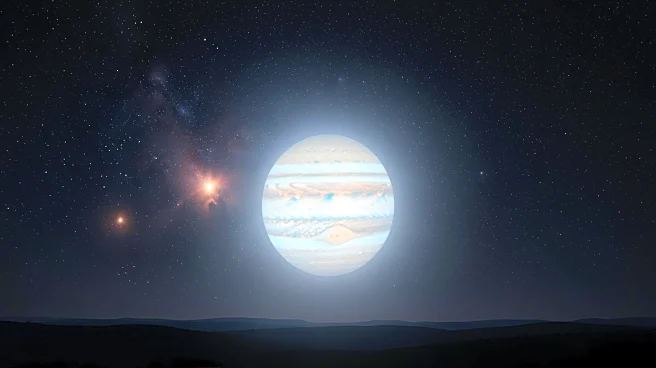
The Kenya Space Agency (KSA) is encouraging stargazers to observe a rare celestial event where Jupiter will appear larger and brighter than usual. This phenomenon occurs as Earth aligns directly between
the Sun and Jupiter, a positioning known as opposition. During this event, Jupiter will be visible all night, shining brightly in the constellation Gemini. The KSA advises viewers to look towards the eastern sky after sunset to witness this spectacle. While the planet can be seen with the naked eye, using binoculars or a telescope will enhance the viewing experience, allowing observers to see Jupiter's four largest moons and its colorful atmospheric cloud bands. The Stellarium app is recommended for locating the constellation Gemini and Jupiter. This event marks Jupiter's most spectacular appearance of the year, as it reaches its closest point to Earth in its orbit.
Why It's Important?
This astronomical event is significant as it provides a unique opportunity for both amateur and professional astronomers to observe Jupiter in its full glory. The alignment, known as opposition, allows for optimal viewing conditions, making it an ideal time for educational and observational activities related to astronomy. Such events can inspire interest in space science and foster a greater appreciation for celestial phenomena. Additionally, the visibility of Jupiter's moons and atmospheric features through telescopes can contribute to ongoing scientific studies and public engagement with space exploration. This event underscores the importance of space agencies in promoting scientific literacy and encouraging public participation in astronomical observations.
What's Next?
Following this event, stargazers and astronomers may continue to track Jupiter's movements and observe other celestial phenomena. The Kenya Space Agency and similar organizations might use this opportunity to promote further educational programs and public outreach initiatives related to astronomy. As interest in space science grows, there could be increased investment in astronomical research and technology, potentially leading to new discoveries and advancements in our understanding of the solar system. Future celestial events may also be highlighted to maintain public interest and engagement in space exploration.