





What's Happening?
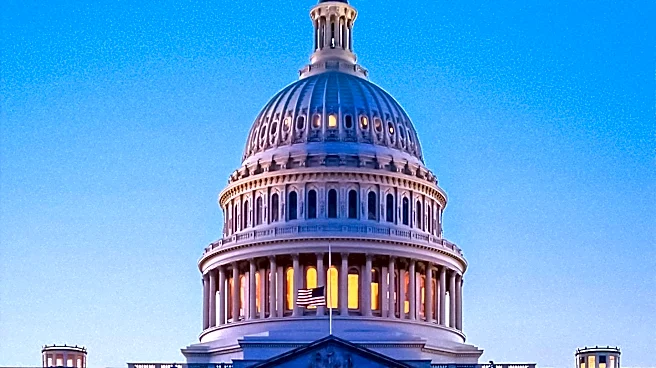
Congress passed a continuing resolution (CR) on September 1, extending current spending levels through December 11. This action puts on hold the Pentagon's request for $1.5 trillion in spending authority for fiscal year 2027. The House of Representatives
agreed to the Senate's timeline with a 370-48 vote, and President Trump is expected to sign the bill into law. Under a CR, federal government funding remains at the previous fiscal year's levels, which means the Department of Defense (DoD) will operate with an $838.5 billion budget, significantly less than its requested $1.5 trillion. This marks the 38th time in 50 years that the DoD will begin a fiscal year with a temporary spending measure. The Pentagon's budget request was divided into two parts: $1.15 trillion through the usual appropriations process and $350 billion through the reconciliation process, neither of which has seen meaningful movement in Congress.
Why It's Important?
The passage of a short-term funding bill has significant implications for the Department of Defense and national security. Operating under a continuing resolution typically prevents the initiation of new programs, delays contracts, and slows training events, which can hinder military readiness and modernization efforts. The substantial difference between the requested $1.5 trillion and the CR-mandated $838.5 billion means critical programs, such as the Golden Dome for America missile defense shield and the Air Force's F-15EX program, face severe funding shortfalls. For instance, the F-15EX program will start 2027 with only $115 million, less than 5% of its requested $2.65 billion. This financial uncertainty can create bottlenecks in contracting and project completion, potentially impacting the U.S.'s ability to maintain its defense capabilities and respond to emerging threats effectively.
What's Next?
The Pentagon will operate under the continuing resolution until December 11, during which time Congress will need to address the full fiscal year 2027 budget. Lawmakers face the challenge of reconciling differing budget proposals, with the House having advanced a base spending measure of $1.07 trillion for defense, while the Senate has yet to agree on a topline. The $350 billion reconciliation request remains largely unaddressed. Some Republicans may attempt another reconciliation bill after the midterm elections to address the 2027 budget, but intra-party disagreements on funding mechanisms could complicate this effort. Defense budget watchers remain skeptical about the outlook for the full $1.5 trillion budget, with some predicting that the base budget may not clear Congress until spring 2027, potentially leading to further delays in obligating funds and implementing critical defense initiatives.
Beyond the Headlines
The recurring reliance on continuing resolutions for defense funding highlights a systemic issue in the U.S. budgetary process, often driven by political gridlock and partisan disagreements. This pattern of short-term funding creates instability and inefficiency within the Department of Defense, forcing military leaders to make difficult decisions about prioritizing existing programs over new, essential investments. The long-term consequences include potential erosion of technological advantages, delays in critical research and development, and increased costs due to stop-and-go funding. This situation also impacts the defense industrial base, as contractors face uncertainty, which can deter investment and innovation. Ultimately, the inability to pass timely and comprehensive defense budgets undermines strategic planning and can have far-reaching implications for U.S. global leadership and national security posture.