
What's Happening?
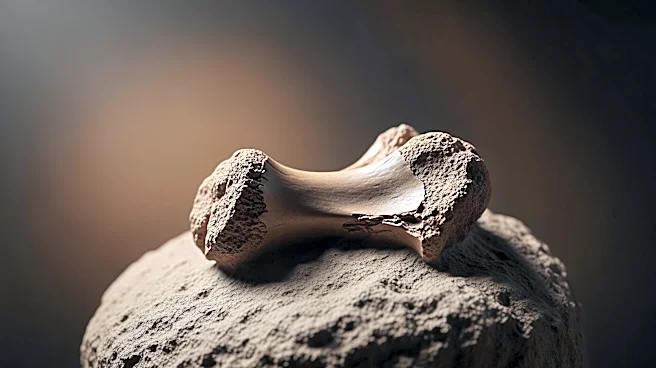
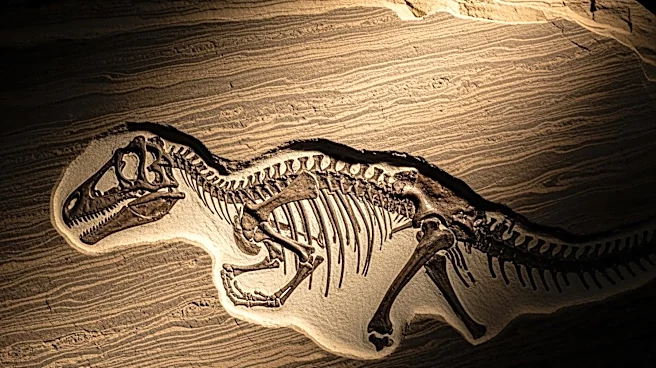
A team of paleontologists has unearthed a dog-sized dinosaur from the Middle Jurassic period on the Isle of Skye, Scotland. The dinosaur, which lived approximately 166 million years ago, was a herbivore
and is the most complete dinosaur skeleton found in Scotland to date. The fossil was discovered in a challenging location, embedded in hard limestone along a rocky coastline, accessible only at low tide. The extraction required significant effort, including the use of ropes, wedges, and a motorboat. The dinosaur is believed to be an ornithischian, a group of plant-eating dinosaurs, and its discovery provides valuable insights into the evolution of dinosaurs during the Middle Jurassic period.
Why It's Important?
This discovery is significant as it fills a gap in the fossil record of the Middle Jurassic period, a time from which well-preserved dinosaur skeletons are rare. The findings contribute to the understanding of dinosaur evolution, particularly the diversification of herbivorous species. The research could help scientists map out evolutionary traits and the timeline of when certain dinosaur species emerged. The discovery also highlights the potential for further significant finds in the region, encouraging additional paleontological exploration on the Isle of Skye.
What's Next?
Further fieldwork is planned on the Isle of Skye to uncover more fossils that could provide additional insights into the Middle Jurassic period. Researchers aim to compare the newly discovered dinosaur with other similar species to confirm its classification and understand its evolutionary significance. The team will continue to study the fossilized remains to gather more information about the dinosaur's life and environment.