




What's Happening?
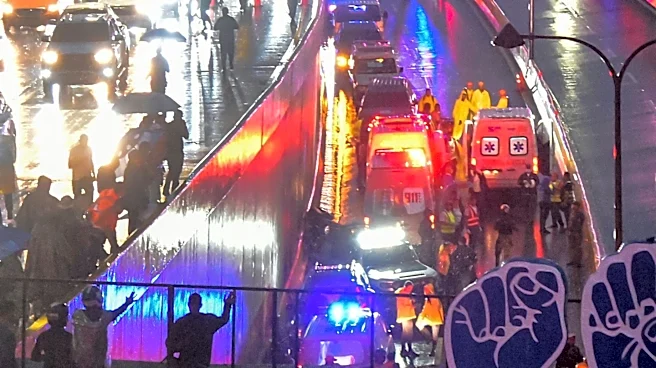
The Metropolitan Washington Council of Governments (MWCOG) has identified a significant increase in pedestrian and cyclist crashes following the fall daylight saving time change. This spike is attributed to earlier sunsets, which lead to reduced visibility
during peak travel hours. According to Ragina Ali, public and government affairs manager for AAA in the D.C. region, fatal crashes involving pedestrians and bicyclists rise by approximately 13% in the five weeks after the time change. Additionally, car crashes involving animals, particularly deer, increase by about 6% in the first four weeks. Clark Mercer, MWCOG's executive director, emphasized the need for education, street engineering to control vehicle speeds, and law enforcement to mitigate these dangers. A study also indicated a 7.1% decrease in fatal crashes among motor-vehicle occupants but a 13% increase for pedestrians/bicyclists after the fall time change.
Why It's Important?
The increased risk to pedestrians and cyclists after the daylight saving time change represents a critical public safety concern in the D.C. metro region. This annual phenomenon highlights systemic issues in urban planning, driver behavior, and pedestrian infrastructure. The statistics underscore the vulnerability of non-motorized commuters, who face heightened dangers due to decreased visibility and potentially drowsy drivers. For local governments, this necessitates a proactive approach to road safety, including targeted public awareness campaigns, infrastructure improvements like better lighting and pedestrian crossings, and stricter enforcement of traffic laws. The economic impact can also be significant, with increased healthcare costs from injuries and potential productivity losses. Addressing this issue is vital for promoting sustainable transportation options and ensuring the well-being of all road users in the region.
What's Next?
In response to the heightened risks, the Metropolitan Washington Council of Governments, through its Street Smart campaign, is advocating for a multi-pronged approach. This includes educating the public on mindful road use, especially during the post-daylight saving period. Furthermore, there's a call for engineering streets to encourage slower vehicle speeds and for consistent enforcement of traffic laws. Individuals are advised to adjust their schedules gradually to combat drowsiness and to be extra vigilant on the roads. As this is an annual concern, ongoing efforts in public education and infrastructure improvements are expected to continue. The long-term goal is to reduce the number of pedestrian and bicycle crashes, making regional roadways safer for everyone, regardless of the time of year or daylight conditions.
Beyond the Headlines
The recurring issue of increased pedestrian and cyclist accidents after daylight saving time points to a broader debate about the utility and impact of changing clocks. Beyond the immediate safety concerns, the time change can disrupt circadian rhythms, potentially affecting public health and productivity. The D.C. metro region's experience highlights how seemingly minor policy decisions can have significant, measurable consequences on daily life and public safety. This situation also underscores the need for integrated urban planning that prioritizes vulnerable road users and adapts to environmental changes, such as reduced daylight. The discussion around daylight saving time often focuses on energy conservation, but its implications for transportation safety and public health warrant greater consideration in policy debates at both local and national levels.