

What's Happening?
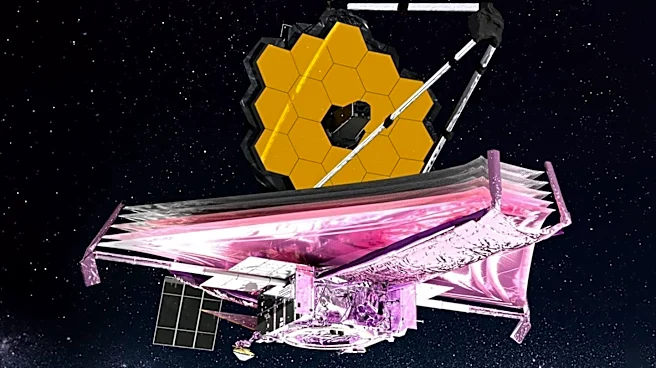
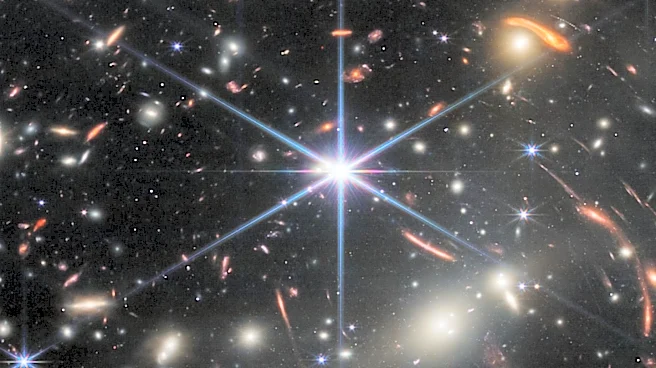
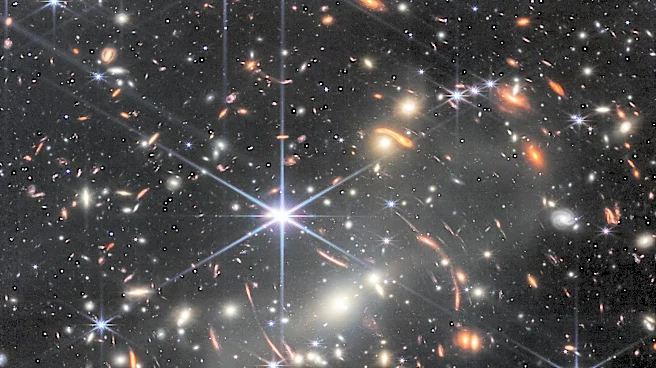
Observations of the extremely distant galaxy JADES-GS-z14-0, seen when the universe was less than 300 million years old, have revealed the presence of oxygen. The James Webb Space Telescope (JWST) initially identified this galaxy, and subsequent observations
in 2025 by the Atacama Large Millimeter/submillimeter Array (ALMA) detected oxygen within it. Oxygen is a heavier element than hydrogen or helium, produced inside stars and dispersed into space through stellar winds and deaths. This finding is significant because it suggests that stars had already formed, evolved, and enriched the galaxy with heavier elements remarkably early in cosmic history. While this does not disprove the Big Bang model or the Lambda-CDM model, it challenges existing assumptions about the efficiency of star formation, stellar populations, dust content, and the growth of early galaxies.
Why It's Important?
The detection of oxygen in JADES-GS-z14-0 at such an early cosmic epoch is important for refining our understanding of the universe's initial stages. It indicates a more rapid chemical enrichment and stellar evolution than previously anticipated, suggesting that the processes of star formation and heavy element production were highly efficient in the very young universe. This challenges current cosmological models, particularly those concerning the assembly speed of the first stars and galaxies. Scientists will need to re-evaluate parameters related to star-formation efficiency, the characteristics of early stellar populations, and the role of dust in these nascent galaxies. This discovery provides crucial empirical data that will help astronomers and cosmologists test and refine the standard cosmological framework, potentially leading to a more accurate picture of how the universe evolved from its hot, dense beginnings.
What's Next?
The discovery of early oxygen enrichment in JADES-GS-z14-0 will likely spur further observational campaigns using advanced telescopes like JWST and ALMA to identify similar distant galaxies and analyze their chemical compositions. Researchers will focus on gathering more data to confirm the prevalence of such rapid enrichment and to understand the specific conditions that enabled it. Theoretical astrophysicists will work on adjusting existing galaxy formation and evolution models to incorporate these new findings, potentially leading to revised timelines for stellar evolution and heavy element production in the early universe. This will involve re-evaluating assumptions about the initial mass function of stars, the rates of supernovae, and the mechanisms of gas and dust dispersal in young galaxies. The scientific community will also be looking for other unexpected observations that could further challenge or refine the Lambda-CDM model.
Beyond the Headlines
This discovery has profound implications for our understanding of cosmic evolution and the origins of elements essential for life. The rapid appearance of heavy elements like oxygen suggests that the building blocks for complex chemistry, and potentially life, were available much earlier in the universe's history than previously thought. This could influence theories about the habitability of early exoplanets and the timeline for the emergence of life. Furthermore, it highlights the ongoing dynamic nature of scientific inquiry, where new observational data constantly tests and refines established theories. The unexpected maturity of JADES-GS-z14-0 serves as a reminder that our current cosmological models, while highly successful, are continuously subject to revision as our observational capabilities improve, pushing the boundaries of what we know about the universe's earliest moments.