




What's Happening?
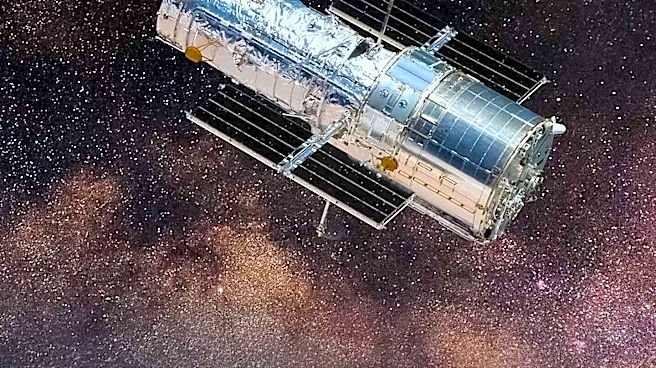
NASA’s Hubble Space Telescope has provided definitive evidence of a significant merger event in the early history of the Milky Way galaxy, occurring approximately 11.8 billion years ago. This discovery pushes back the known timeline of our galaxy's evolution
by 1.8 billion years. Researchers, led by Davide Massari from the Astrophysics and Space Science Observatory of Bologna, identified a third population of globular star clusters in the inner regions of the Milky Way. These clusters are older than those from the Gaia-Sausage-Enceladus merger (10 billion years ago) but younger than the Milky Way's original clusters. This indicates they originated from a dwarf galaxy, named Low-energy-Kraken-Heracles (LKH), which merged with the nascent Milky Way. The LKH dwarf galaxy is estimated to have contained about 500 million times the mass of the Sun in stars, representing a substantial fraction of the Milky Way's mass at that time. The findings were published in the journal Nature Astronomy.
Why It's Important?
This discovery significantly enhances our understanding of the Milky Way's formation and evolution, impacting the field of astrophysics and cosmology. By identifying an earlier, massive merger, scientists can refine models of galaxy growth and the processes that shaped our cosmic neighborhood. This new timeline provides crucial context for studying the distribution of stars, gas, and dark matter within our galaxy, and how these components interacted during its formative years. For U.S. scientific institutions like NASA and the Space Telescope Science Institute, this research underscores the continued value and groundbreaking capabilities of the Hubble Space Telescope, even after decades of operation. It also highlights the importance of international collaborations, such as with the European Space Agency (ESA), in advancing fundamental scientific knowledge. The findings challenge previous assumptions that the earliest phases of our galaxy's evolution were solely defined by stars born within it, emphasizing the role of external galaxies in its construction.
What's Next?
Researchers plan to continue their study of the Milky Way's globular clusters to unravel more of its cosmic history, aiming to characterize all the massive mergers the galaxy has experienced. Future observations with Hubble and other advanced telescopes, such as the James Webb Space Telescope, will likely provide even more detailed data on these ancient stellar populations. This ongoing research could lead to a more complete 'archaeological map' of the Milky Way, revealing the sequence and impact of various merger events. Scientists will also likely use these findings to refine simulations of galaxy formation, testing how well current theoretical models align with the newly discovered empirical evidence. The insights gained could also inform the search for similar early merger events in other galaxies, providing a broader understanding of universal galaxy evolution processes.
Beyond the Headlines
Beyond the scientific implications, this discovery offers a profound perspective on our place in the universe. Understanding the violent and dynamic history of our home galaxy, built through the absorption of smaller galaxies, provides a deeper appreciation for the complex cosmic processes that led to the formation of our solar system and, ultimately, life. It highlights the concept of 'cosmic archaeology,' where ancient stellar remnants act as historical markers, preserving clues about events billions of years ago. This research also underscores the enduring human quest for knowledge about origins, from the Big Bang to the formation of our own galaxy. The continued success of the Hubble Space Telescope, a testament to human ingenuity and international cooperation, serves as an inspiration for future generations of scientists and engineers, demonstrating the long-term impact of sustained investment in space exploration and fundamental research.