








What's Happening?
The UK is significantly expanding its national drone testing facility at Westcott, known as the National Autonomy and Drone Innovation Centre (NADIC). This expansion, led by the Satellite Applications Catapult, will introduce new capabilities designed
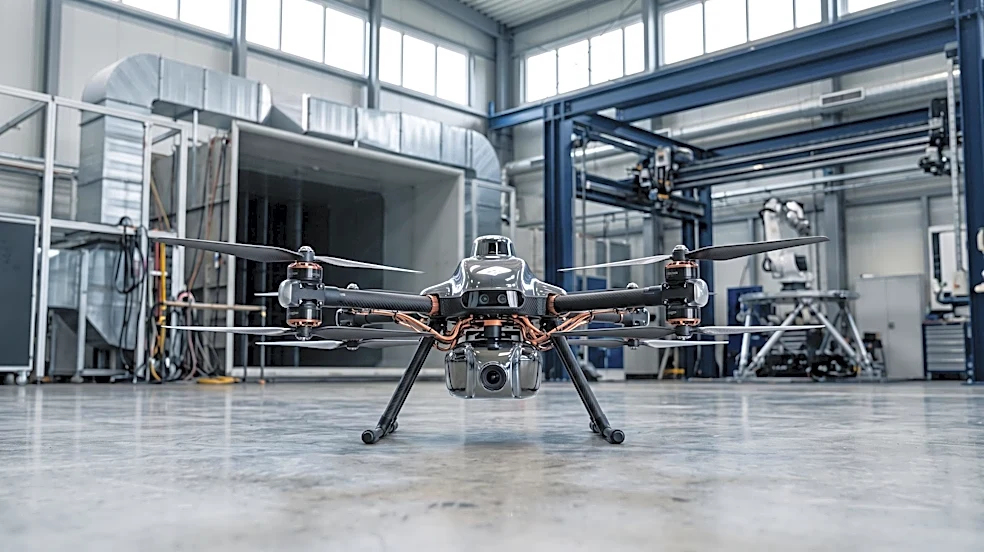
to assess navigation resilience, wind response, communications, and remote operations for drones. Key additions include Position, Navigation, and Timing (PNT) testing facilities to evaluate system performance when satellite navigation signals are unavailable or compromised. A Satellite Communications Integration and Test Lab will validate drone and autonomous systems across various networks for beyond-visual-line-of-sight (BVLOS) operations. The center will also feature a Windshaper system for precise indoor wind condition generation, a robotic arm for automated testing, and a motion platform to simulate operations on moving vessels and uneven terrain. A Remote Operations Control Centre will facilitate training, mission simulation, and validation of remote command-and-control procedures. The robotic arm, motion platform, and control room are expected to be operational in the coming months, with the full facility anticipated in the second half of 2027.
Why It's Important?
This expansion is crucial for the advancement of the UK's drone industry, particularly for small and medium-sized companies and component builders. It addresses a significant challenge in the sector: the need for standardized and verifiable evidence of safety and performance for regulatory applications. Currently, almost every commercial drone flight in the UK requires individual authorization, demanding operators to prove the safety of specific operations. The Civil Aviation Authority has acknowledged that current bespoke approvals are insufficient to support widespread commercial use. NADIC will provide a critical infrastructure for companies to establish operational limits under controlled conditions and generate data that can be directly used for regulatory compliance. This initiative is aligned with the UK government's target of establishing routine BVLOS drone flight by 2027 and its forecast for the UK drone economy to reach up to £45 billion (US$60 billion) by 2030. The investment, including £2.25 million (US$3 million) from Buckinghamshire Council, underscores the national commitment to fostering innovation and economic growth in this sector.
What's Next?
The immediate next steps involve the operationalization of the robotic arm, motion platform, and control room in the coming months, followed by the full facility becoming operational in the second half of 2027. Once fully established, NADIC is expected to significantly streamline the process for drone companies to develop and certify their technologies. This will likely lead to an acceleration in the adoption of BVLOS drone operations across various industries, including logistics, infrastructure inspection, and emergency services. The availability of robust testing and certification facilities will also enhance the UK's position as a leader in drone technology and innovation. Furthermore, the center's focus on navigation resilience and satellite communications will contribute to the development of more reliable and secure drone systems, which is vital for their integration into national airspace. The success of NADIC could also serve as a model for other countries looking to develop similar infrastructure to support their burgeoning drone industries.
Beyond the Headlines
The expansion of NADIC has deeper implications beyond simply facilitating drone testing. It represents a strategic investment in the future of autonomous systems and their integration into daily life. The focus on PNT testing and satellite communications highlights the increasing reliance on advanced digital infrastructure for critical operations. This initiative could foster a new ecosystem of innovation, attracting talent and investment to the UK's aerospace and technology sectors. Ethically, the development of robust testing protocols for drone safety is paramount, as the widespread use of BVLOS drones raises concerns about privacy, security, and public acceptance. The center's role in generating verifiable data for regulators will be crucial in building public trust and ensuring responsible deployment. Culturally, the normalization of drone operations, enabled by such testing facilities, could transform various industries and aspects of society, from package delivery to environmental monitoring, leading to long-term shifts in how services are delivered and managed.