




What's Happening?
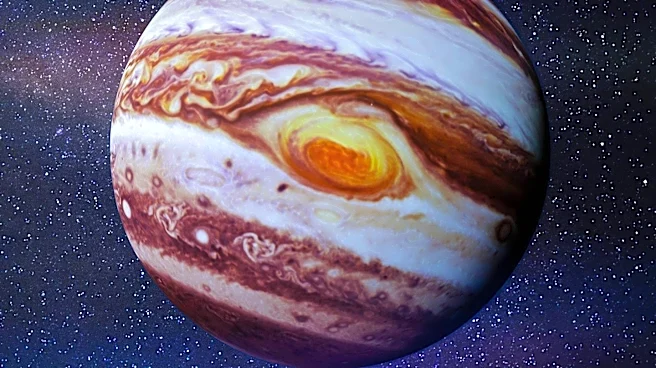
Jupiter, the largest planet in our solar system, presents a unique challenge for spacecraft due to its lack of a solid surface. As a spacecraft descends into Jupiter, it would encounter an atmosphere that becomes progressively denser and hotter, eventually
transforming into a supercritical fluid. This environment would destroy any probe long before it could reach a solid core, which may not even exist as a distinct boundary. NASA's Juno mission has provided insights into Jupiter's interior, suggesting a core that is extended and diluted, with heavy materials mixed into hydrogen.
Why It's Important?
Understanding Jupiter's atmosphere and interior is crucial for planetary science and the study of gas giants. The findings from missions like Juno help scientists refine models of planetary formation and dynamics. Jupiter's unique environment challenges our understanding of atmospheric and fluid dynamics, offering insights into the behavior of hydrogen under extreme conditions. This knowledge is essential for future missions to Jupiter and other gas giants, as it informs spacecraft design and mission planning to withstand such harsh environments.
Beyond the Headlines
The study of Jupiter's atmosphere also has implications for understanding exoplanets, particularly gas giants in other solar systems. The behavior of hydrogen and the dynamics of Jupiter's atmosphere can provide analogs for studying similar planets beyond our solar system. Additionally, the exploration of Jupiter's atmosphere contributes to our understanding of magnetic fields and their generation, as the planet's metallic hydrogen layer plays a key role in sustaining its magnetic field.