





What's Happening?
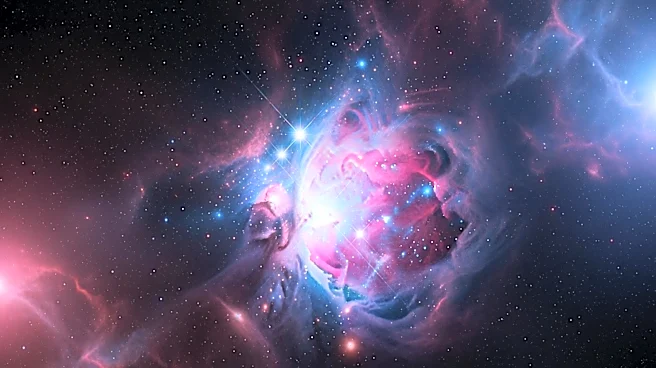
The Hubble Space Telescope, a collaborative project between NASA and the European Space Agency, has released new images of the Trifid Nebula, a star-forming region located approximately 5,000 light-years from Earth. These images, captured with Hubble's
advanced Wide Field Camera 3, reveal intricate details of the nebula, including the presence of young stars and changes in the nebula's structure over time. The telescope, which has been operational since 1990, continues to provide valuable data that contributes to our understanding of the universe. The recent observations highlight the nebula's dynamic environment, shaped by powerful winds from massive stars that trigger new waves of star formation.
Why It's Important?
The Hubble Space Telescope's ongoing observations are crucial for advancing our knowledge of cosmic phenomena. By capturing detailed images of star-forming regions like the Trifid Nebula, Hubble helps astronomers study the processes that lead to star formation and the evolution of nebulae. This information is vital for understanding the lifecycle of stars and the formation of planetary systems. The data collected by Hubble is publicly available, allowing researchers worldwide to conduct further studies and make new discoveries. The collaboration with other telescopes, such as the James Webb Space Telescope, enhances the potential for groundbreaking findings in astrophysics.
What's Next?
Astronomers will continue to analyze the data from Hubble's observations of the Trifid Nebula, comparing it with data from other telescopes like the upcoming Nancy Grace Roman Space Telescope. This comparison will help clarify the processes at work in the nebula and identify new objects of interest for follow-up studies. The ongoing collaboration between Hubble and other telescopes will likely lead to more discoveries about the universe's structure and the formation of stars and galaxies.