





What's Happening?
Researchers at the California Institute of Technology (Caltech) have developed a novel 'light pumping' method that can steer light beams in femtoseconds, significantly faster than previous techniques. This breakthrough utilizes the optical Kerr effect,
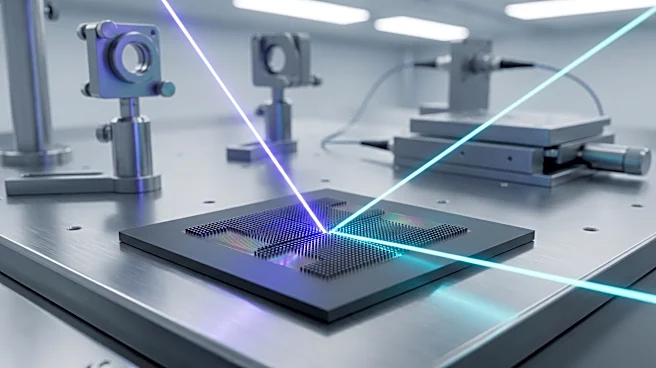
where intense light alters a medium's refractive index, to control the angle of a light beam. Unlike traditional methods that rely on altering the electronic properties of optical chips or liquid crystal panels, which operate in nanoseconds or picoseconds, the Caltech team uses light itself as the steering mechanism. By calibrating an intense 'pump' beam to match the optical composition of a medium, they can then shoot a less intense 'probe' beam through it at a new deflection angle. To enhance this effect, they applied amorphous silicon onto nanoscale pillars, allowing for a deflection angle of up to 13 degrees. This advancement could lead to unprecedented speeds in information transmission and processing.
Why It's Important?
This development holds significant implications for various U.S. industries, particularly in technology and defense. The ability to steer light at femtosecond speeds could revolutionize data transmission, enabling communication speeds far beyond current capabilities. This could lead to vastly superior sensors for moving air and sea vehicles, which currently require complex and slower gravity-bending technologies. For the computing industry, this could mean image processing at rates exceeding a billion images per second, opening doors for advanced artificial intelligence, real-time data analysis, and high-speed scientific simulations. Companies involved in fiber optics, sensor manufacturing, and high-performance computing stand to gain immensely from this research, potentially leading to new product lines and competitive advantages. The U.S. could solidify its leadership in critical technological sectors, impacting national security and economic growth.
What's Next?
The Caltech team aims to further refine their 'light pumping' technique, with the goal of reducing the modulation speed even below 74 femtoseconds. This continued research could push the boundaries into the realm of time crystals and other artificial optical materials, potentially unlocking even more profound capabilities. Future steps will likely involve scaling up this laboratory discovery into practical applications. This could include developing prototypes for ultra-fast optical switches, advanced communication systems, and next-generation sensors. Collaboration between Caltech and technology companies will be crucial for translating this scientific breakthrough into commercial products. The long-term impact could see a fundamental shift in how information is processed and transmitted, influencing everything from consumer electronics to military technology.
Beyond the Headlines
The 'light pumping' innovation by Caltech researchers represents a deeper shift in our understanding and manipulation of light, moving beyond conventional electronic controls to direct light with light itself. This approach taps into the fundamental properties of light-matter interaction at an unprecedented speed, potentially leading to entirely new paradigms in physics and engineering. The ethical implications of such powerful information processing capabilities will need to be considered, particularly concerning data privacy and the potential for misuse in surveillance or autonomous systems. Culturally, this could accelerate the pace of technological advancement, further integrating high-speed data into daily life and potentially creating new forms of digital interaction. The long-term shift could be towards an era where optical computing and communication become the norm, fundamentally altering the digital landscape and our relationship with information.