

What's Happening?
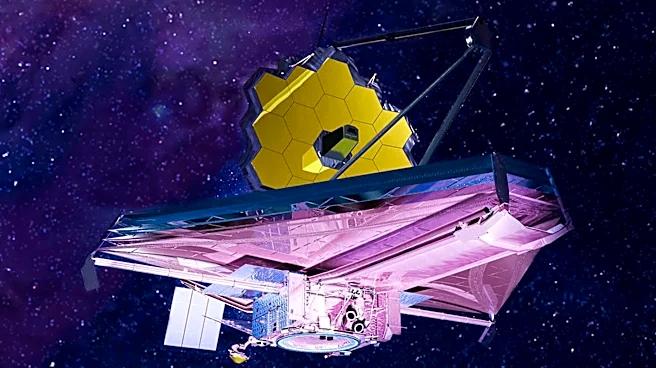
A new study combining data from the Hubble Space Telescope and the James Webb Space Telescope has revealed that the 'Cat's Tail,' a curved plume of dust extending from the Beta Pictoris debris disk, is primarily composed of dark organic carbon. This material
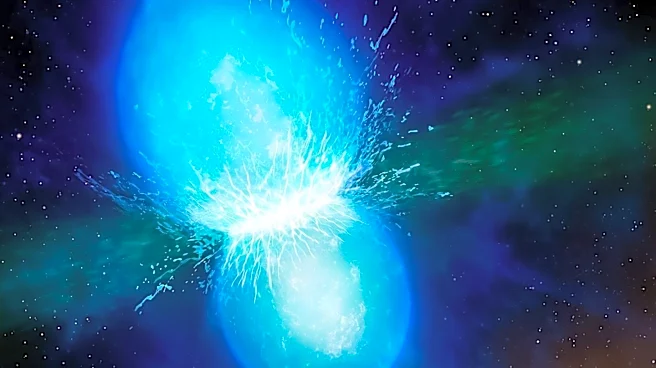
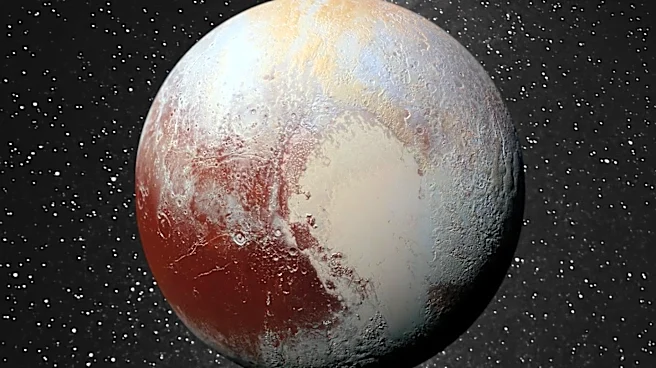
is similar to that found in the most primitive bodies of our solar system. The research, published to arXiv and accepted by The Astrophysical Journal Letters, indicates that this feature is the result of a violent collision between two objects at least as large as Pluto, which occurred approximately a century ago. The study utilized six epochs of Hubble Space Telescope coronagraphic imaging along with JWST mid-infrared data to determine the dust's composition, finding it to be roughly 96 percent organic refractory material. This finding closes a gap in understanding the composition of the Cat's Tail, first captured by JWST in 2024, and suggests the dust originates from the shattered interiors of Kuiper Belt-class objects still spreading through the disk.
Why It's Important?
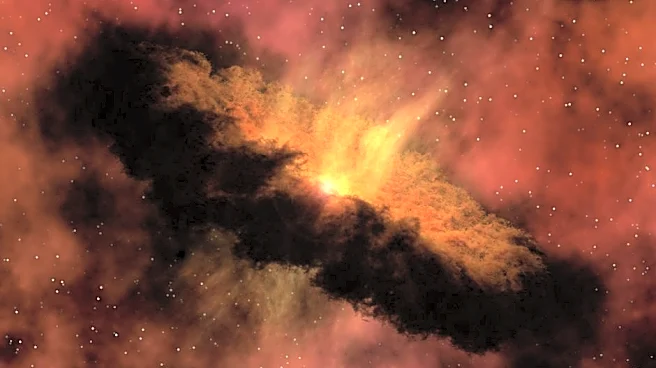
This discovery is significant for astrophysics and planetary science, offering unprecedented insights into the early stages of planetary system formation. Beta Pictoris, a young star system approximately 20 million years old and 63 light-years away, serves as a natural laboratory for studying debris disks and planetary collisions. Understanding the composition of the Cat's Tail provides direct evidence of the violent processes that shape young planetary systems, including the types of materials present and the scale of impacts. The identification of dark organic carbon suggests that the building blocks for complex organic molecules, potentially crucial for life, are abundant in such environments. This research also refines our understanding of how large celestial bodies form and evolve, offering clues about the early history of our own solar system and the prevalence of similar processes in other star systems. The methodology, combining optical and infrared data, establishes a new technique for analyzing the composition of distant debris disk features.
What's Next?
The findings from this study will likely spur further observations of Beta Pictoris and other young debris disk systems using both Hubble and JWST. Scientists may apply the STIS-to-MIRI flux ratio technique, which proved diagnostic in this research, to other nearby debris disks to build a broader 'compositional vocabulary' for extrasolar dust. Future dynamical models of the Beta Pictoris system will need to incorporate these new compositional constraints, particularly regarding the outer halo's morphology and its warp, which may be influenced by inclined planets like Beta Pictoris c or d. The estimated collision timing of approximately 100 years ago also opens avenues for studying the evolution of such debris structures over relatively short astronomical timescales. Continued monitoring could reveal how the Cat's Tail disperses or interacts with other elements of the disk, providing real-time insights into astrophysical processes.
Beyond the Headlines
Beyond the immediate scientific implications, this research contributes to humanity's broader understanding of its place in the universe. The detection of dark organic carbon, a fundamental component of life on Earth, in a distant young star system highlights the universality of these building blocks. This reinforces the idea that the conditions necessary for the emergence of life might be common throughout the cosmos. The study also underscores the power of combining different observational technologies, like Hubble's optical capabilities and JWST's infrared sensitivity, to unlock deeper secrets of the universe. This collaborative approach to space exploration and data analysis is crucial for pushing the boundaries of astronomical knowledge. The ongoing study of systems like Beta Pictoris helps us piece together the cosmic narrative, from the violent birth of planets to the potential for life beyond Earth, fostering a sense of wonder and encouraging continued scientific inquiry.