
What's Happening?
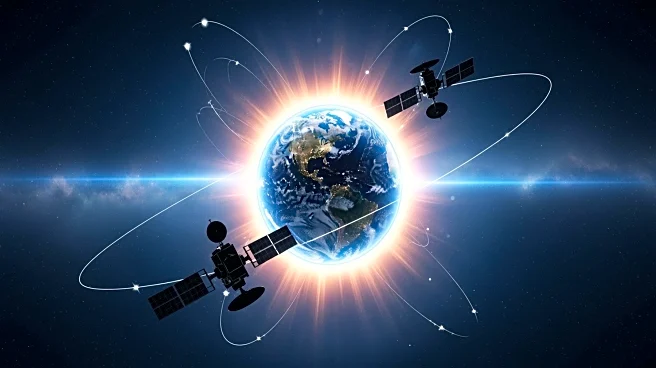
A new study, published on the preprint repository arXiv, introduces the concept of a 'Crash Clock' to predict the time until satellite collisions occur following a severe solar storm. The study, which
has not yet been peer-reviewed, suggests that in low Earth orbit (LEO), where many satellites like SpaceX's Starlink operate, a collision could happen in as little as 2.8 days without avoidance maneuvers. This is a significant decrease from 2018, when it would have taken 128 days for a collision to occur. The study highlights the increased risk due to the growing number of satellites and space debris, which could lead to a cascade of collisions, rendering space unusable.
Why It's Important?
The findings raise critical concerns about the sustainability of space operations as the number of satellites continues to grow. A collision cascade, known as the Kessler syndrome, could have devastating effects on global communications, navigation, and weather monitoring systems. The study underscores the need for improved space traffic management and collision avoidance strategies to prevent such scenarios. It also highlights the vulnerability of satellite operations to solar storms, which can disrupt satellite trajectories and increase collision risks. The potential for a catastrophic chain reaction in space could have far-reaching implications for industries and governments worldwide.