



What's Happening?
A new cosmological model, known as covarying coupling constants plus tired light (CCC+TL), suggests that the universe is 26.7 billion years old, nearly twice the age proposed by the standard Lambda-Cold Dark Matter (ΛCDM) model. Developed by Rajendra
Gupta, an adjunct professor at the University of Ottawa, and postdoctoral researcher Dr. Nikolaos Samaras, this theory posits that fundamental constants governing physical interactions change over cosmic time. These evolving constants could account for phenomena currently attributed to dark matter and dark energy, which have yet to be directly detected despite decades of searching. The CCC+TL model has successfully passed several major cosmological tests, including those related to Big Bang nucleosynthesis and cosmic-chronometer measurements. It also offers an explanation for the existence of surprisingly mature galaxies observed in the early universe, as an older universe would provide more time for their formation.
Why It's Important?
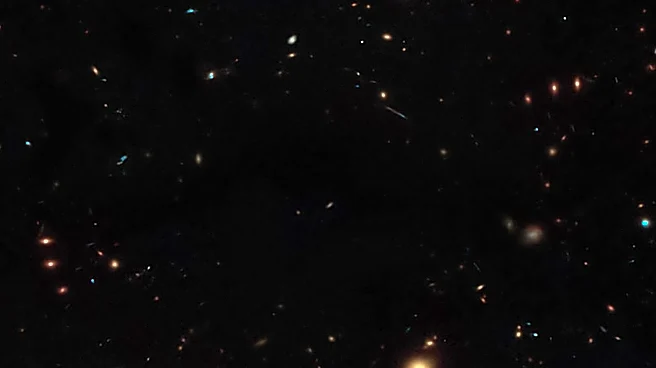
This alternative cosmological model challenges the foundational assumptions of the standard ΛCDM model, which has been the prevailing framework for understanding the universe. If the CCC+TL model gains further validation, it could fundamentally alter our understanding of cosmic history, the composition of the universe, and the forces that govern it. The implications extend to how scientists interpret astronomical observations, particularly those from telescopes like the James Webb Space Telescope, which has observed early, massive galaxies that are difficult to explain within the ΛCDM framework. The potential elimination of dark matter and dark energy from the cosmic inventory would necessitate a complete re-evaluation of theoretical physics and astrophysics, impacting research priorities and funding in these fields. It also highlights the ongoing scientific quest to reconcile theoretical models with observational data, pushing the boundaries of our knowledge about the cosmos.
What's Next?
The CCC+TL model, while promising, requires further rigorous testing and stronger physical justification for its underlying assumptions, particularly regarding the consistent scaling of nuclear reaction rates and neutron decay. Researchers plan to continue testing the model against additional cosmological observations, including the cosmic microwave background challenge. The James Webb Space Telescope's GLIMPSE program, which aims to search for galaxies at very high redshifts, could provide crucial data to either support or refute the CCC+TL model's predictions about the size and mass of early galaxies. The scientific community will closely scrutinize these findings, and if the model continues to hold up, it could lead to a significant paradigm shift in cosmology, prompting new theoretical developments and experimental approaches to understanding the universe.
Beyond the Headlines
The debate between the ΛCDM and CCC+TL models underscores a deeper philosophical tension in science: whether to introduce new, unobservable entities (like dark matter and dark energy) to explain observations, or to modify fundamental laws and constants. The CCC+TL model's success in explaining observations without these hypothetical components could lead to a more parsimonious understanding of the universe. This development also highlights the dynamic nature of scientific inquiry, where established theories are constantly challenged and refined by new data and innovative ideas. The implications could extend beyond cosmology, potentially influencing other areas of physics that rely on the constancy of fundamental physical laws. The ongoing search for dark matter and dark energy, and the emergence of alternative theories, reflects the scientific community's commitment to questioning and exploring the unknown, even when it means re-evaluating long-held beliefs.