






What's Happening?
Poland recently hosted its largest ever military parade on Armed Forces Day, showcasing a significant military modernization drive aimed at strengthening NATO’s eastern flank against the threat from Russia. The event featured more than 60 military aircraft,
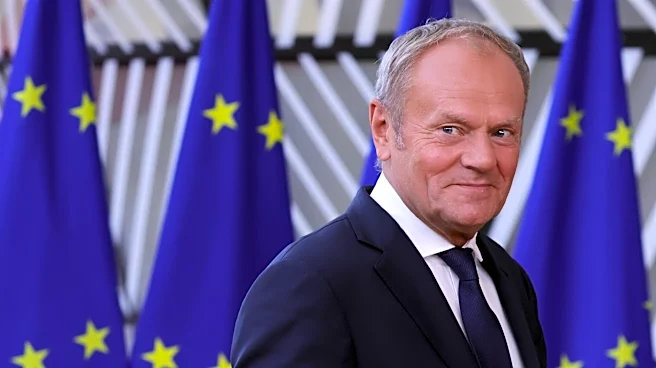
including US-designed F-35 fighter jets, and a ground display of over 300 military vehicles and nearly 2,000 Polish troops. Prime Minister Donald Tusk stated that 'only those who are strong, well-prepared, truly independent and sovereign will avoid war,' underscoring the nation's commitment to deterrence. President Karol Nawrocki also emphasized Poland's historical understanding of the price of independence and freedom, calling for national unity despite political differences. Poland has rapidly increased its defense spending, allocating approximately 4.7% of its GDP to defense in 2025, the highest among NATO members, with plans to reach 5% in 2026. The country has also made substantial acquisitions, including 32 F-35s, 96 AH-64E Apache helicopters from the US, and new frigates and submarines.
Why It's Important?
Poland's aggressive military modernization and increased defense spending significantly bolster NATO's collective defense capabilities, particularly on its eastern flank, which directly borders Russia and Ukraine. This strategic enhancement serves as a critical deterrent against potential Russian aggression, contributing to regional stability in Europe. The substantial investment in US-made military hardware, such as F-35 fighter jets and AH-64E Apache helicopters, represents a significant boost for American defense industries and reinforces the strategic alliance between the US and Poland. This commitment to advanced military technology and a larger, more capable fighting force (targeting 500,000 service members by 2039) demonstrates a clear shift in European defense priorities following Russia's full-scale invasion of Ukraine, potentially influencing other NATO members to increase their own defense expenditures and modernization efforts. For the U.S., a stronger, more secure NATO ally in a critical geopolitical region reduces the burden of direct intervention and enhances overall alliance security.
What's Next?
Poland is set to continue its ambitious defense spending, aiming to increase it to 5% of its GDP in 2026, further solidifying its position as a leading defense spender within NATO. The nation also plans to expand its armed forces to 500,000 service members, including 200,000 reservists, by 2039, which will make it one of the largest militaries in NATO. This ongoing buildup will likely involve further acquisitions of advanced military hardware from international partners, including the United States. The emphasis on national unity by political leaders suggests a sustained, bipartisan commitment to defense, despite internal political tensions over financing mechanisms like the EU's multi-billion SAFE loan program. This trajectory indicates a long-term commitment to maintaining a robust deterrent posture against perceived threats, which will continue to shape the security landscape of Eastern Europe and NATO's strategic planning.
Beyond the Headlines
The scale of Poland's military buildup and the rhetoric surrounding it reflect a deep-seated historical consciousness regarding national security and sovereignty, particularly given its geographical position between powerful neighbors. The public display of military strength, coupled with calls for national unity, underscores a collective resolve to avoid past vulnerabilities. This aggressive rearmament could trigger a broader security dilemma in the region, potentially leading to increased military spending and modernization efforts by other nations bordering Russia. Furthermore, Poland's significant investment in advanced Western military technology could deepen interoperability within NATO, but also raises questions about the long-term economic sustainability of such high defense expenditures. The focus on deterrence through strength also highlights a shift away from post-Cold War disarmament trends, signaling a new era of heightened military preparedness in Europe.