





What's Happening?
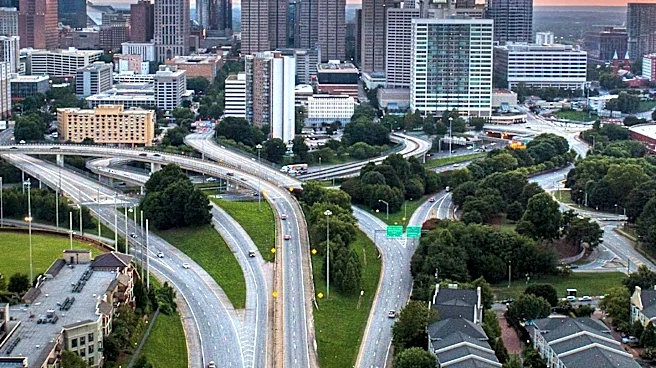
Interstate 285 in Southwest Atlanta experienced a significant delay in its reopening on Monday morning, causing approximately two and a half hours of unexpected traffic disruption. The interstate had been closed for construction from Friday at 7 p.m.
until Monday morning. The Georgia Department of Transportation (GDOT) reported that the contractor, Webber, failed to meet the scheduled reopening deadline of 5 a.m. on Monday. Despite assurances from Webber as late as Sunday night that the deadline would be met, the road did not reopen until around 7:30 a.m. This delay impacted numerous commuters, including Bruce Price, who missed an important meeting with his contractor, and Shannon Byrd-Crossley, who was late for work. GDOT issued an apology for the delay and indicated that it would re-evaluate the production rates provided by the contractor to prevent future closure extensions.
Why It's Important?
The unexpected delay in the reopening of a major interstate like I-285 has significant economic and social repercussions for the Atlanta metropolitan area. Commuters faced extended travel times, leading to missed appointments, lost productivity, and increased frustration. For individuals like Bruce Price, who was on a tight schedule for a home renovation, the delay had a direct financial impact by disrupting his ability to meet with contractors and potentially pushing back project timelines. Businesses relying on timely deliveries or employee punctuality also suffered from the unforeseen traffic congestion. This incident highlights the critical importance of reliable infrastructure project management and the ripple effect that even short delays can have on a bustling urban economy. It also underscores the public's reliance on accurate communication from transportation authorities and contractors regarding road closures and reopening schedules.
What's Next?
GDOT has stated its intention to re-evaluate the production rates provided by Webber, the contractor responsible for the delay, to prevent similar incidents in the future. This re-evaluation could lead to stricter contractual terms, increased oversight, or penalties for contractors who fail to meet agreed-upon deadlines. Commuters and local businesses will likely be looking for assurances from GDOT that such disruptions will be minimized. There may also be a push for improved communication protocols to inform the public more effectively about potential delays. The incident could prompt a broader review of how large-scale infrastructure projects are managed in Georgia, focusing on accountability and contingency planning to mitigate the impact of unforeseen challenges on the public.
Beyond the Headlines
This incident extends beyond a simple traffic delay, touching upon the broader challenges of urban infrastructure development and public trust. The failure of a contractor to meet a promised deadline, despite prior assurances, can erode public confidence in large-scale government projects and the private entities contracted to execute them. It also brings to light the complex logistics involved in managing major highway construction, where unforeseen issues can have widespread consequences. The reliance on contractors for critical public services necessitates robust oversight and accountability mechanisms. Furthermore, the incident underscores the vulnerability of modern urban life to disruptions in transportation networks, emphasizing the need for resilient infrastructure planning and effective communication strategies to manage public expectations and minimize inconvenience during essential maintenance and development work.