




What's Happening?
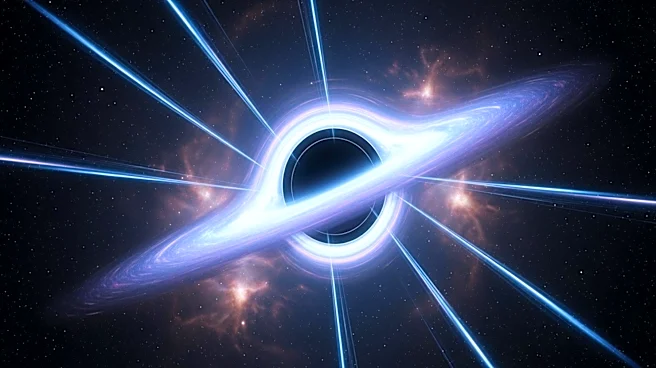
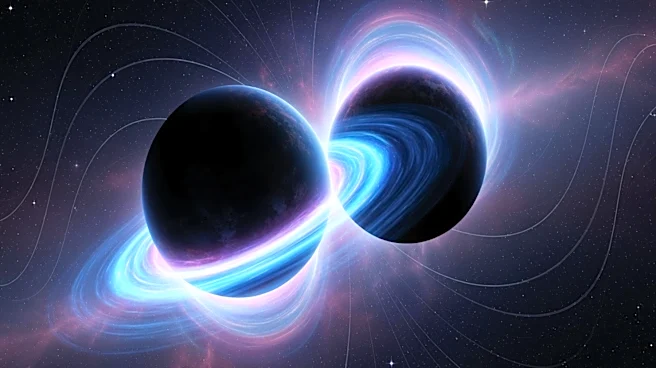
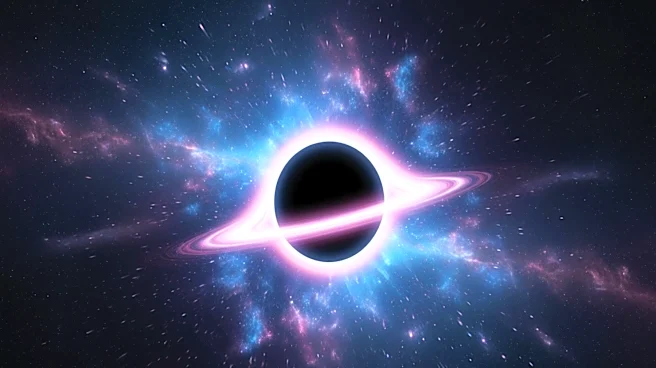
A team of physicists at the University of Portsmouth has proposed a new theory suggesting that the universe was created by a massive 'bounce' from an ancient black hole, challenging the traditional Big Bang theory. This 'Black Hole Universe' theory posits
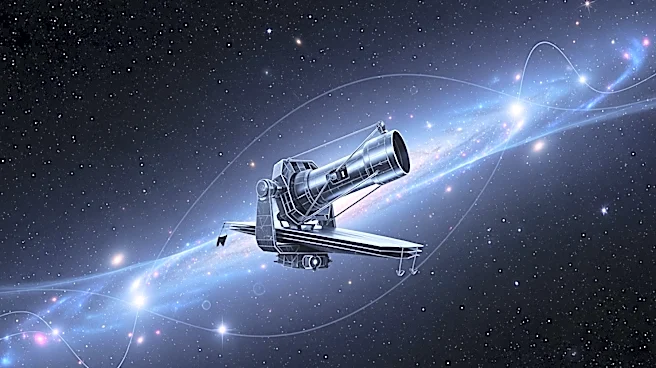
that the cosmos did not emerge from an explosion of matter but rather rebounded from a contraction phase. The idea, first introduced by Indian physicist Raj Kumar Pathria in the 1970s, has gained traction with recent data from the James Webb Space Telescope. This data shows an imbalance in the spin directions of ancient galaxies, supporting the theory that the universe was born spinning from a rotating black hole.
Why It's Important?
This new theory could revolutionize our understanding of the universe's origins, challenging the long-standing Big Bang model. If proven, it would have profound implications for cosmology and physics, potentially altering the foundational principles of these fields. The theory also opens up new avenues for research into black holes and their role in the universe's formation. It could lead to a reevaluation of existing astronomical data and inspire new scientific inquiries into the nature of space and time.
Beyond the Headlines
The acceptance of this theory could shift the focus of cosmological research towards understanding the mechanics of black holes and their potential to create new universes. It raises philosophical questions about the nature of existence and the possibility of multiple universes. The theory also highlights the importance of technological advancements, like the James Webb Space Telescope, in expanding our understanding of the cosmos. As more data becomes available, the scientific community will need to reassess long-held beliefs and consider the broader implications of a universe born from a black hole.