
What's Happening?
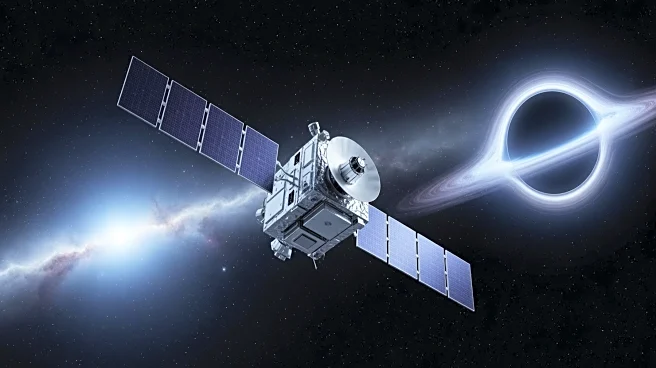
NASA has launched two new CubeSats, the Star-Planet Activity Research CubeSat (SPARCS) and the Black Hole Coded Aperture Telescope (BlackCAT), aboard a SpaceX mission from Vandenberg Space Force Base.
These small satellites are designed to study low-mass stars and black holes, respectively. SPARCS will focus on ultraviolet emissions from stars to understand their impact on surrounding planets, while BlackCAT will conduct a wide-field X-ray survey to detect gamma-ray bursts and black hole formations. This mission is part of a broader effort to utilize small, cost-effective satellites for advanced space research.
Why It's Important?
The deployment of SPARCS and BlackCAT represents a significant advancement in space research, leveraging the cost-effectiveness and flexibility of CubeSats. These missions will provide valuable data on stellar activity and cosmic phenomena, contributing to our understanding of the universe. The success of these CubeSats could pave the way for future small satellite missions, democratizing space exploration and enabling more institutions to participate in cutting-edge research. This initiative highlights the growing trend of using innovative technologies to expand scientific capabilities in space.