








What's Happening?
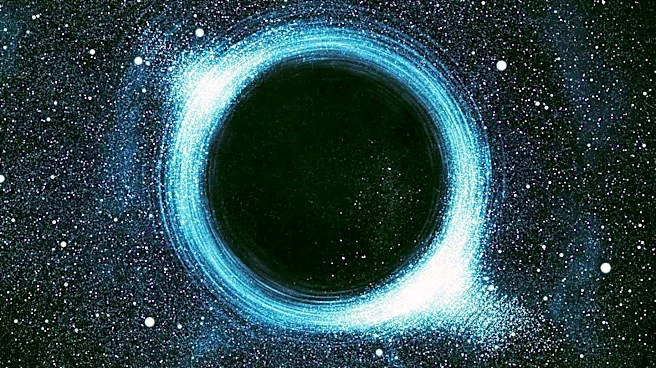
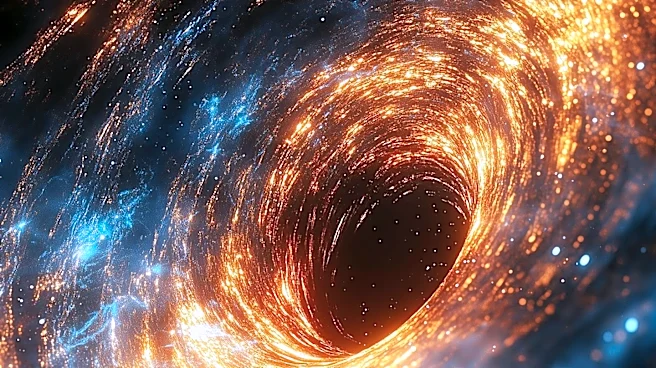
Researchers have introduced a new approach to black hole thermodynamics that addresses a significant limitation in Stephen Hawking's theories. The study, led by Abhay Ashtekar at Penn State, proposes a method to describe black holes that are not in equilibrium,
which is a common state as they form, merge, and evaporate. This new method involves a revised measure of a black hole's entropy, which is more closely linked to its spin and energy. The findings, published in Physical Review Letters, aim to extend the laws of thermodynamics to dynamic black holes, potentially enhancing the understanding of phenomena such as black hole mergers and evaporation.
Why It's Important?
This development is crucial as it addresses a long-standing issue in the field of black hole physics. By providing a framework that applies to non-equilibrium black holes, the research could significantly impact the study of cosmic events and the application of quantum mechanics to astrophysical phenomena. The ability to better understand black hole dynamics could lead to advancements in gravitational wave research and improve the accuracy of simulations used in astrophysics. This could benefit scientific communities focused on understanding the universe's most extreme environments.
What's Next?
The new framework is expected to be applied to ongoing research in black hole dynamics, particularly in the context of gravitational wave detection by collaborations like LIGO-Virgo-KAGRA. Future studies may focus on refining the model and exploring its implications for quantum theory and black hole mergers. The research community will likely investigate how this approach can be integrated into existing models and simulations to enhance the predictive power of black hole behavior.