





What's Happening?
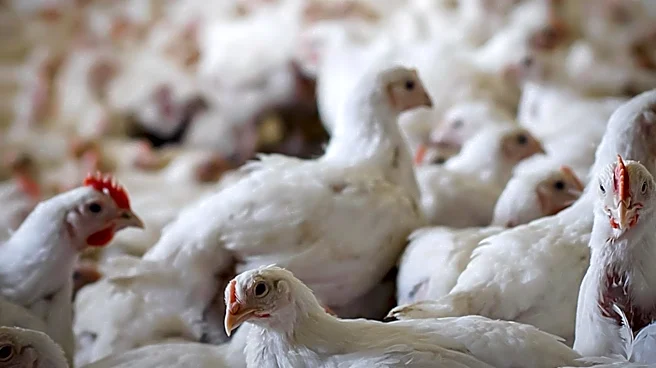
Researchers have developed DOLD-Net, a novel AI model designed for dense occluded livestock detection. This system, detailed in a recent study, significantly improves the accuracy of identifying livestock even when animals are closely grouped or partially
hidden. DOLD-Net utilizes a Dual-Branch Occlusion-Aware Network (DBOAN) and a Context-Guided Focus Propagation (CGFP) framework to achieve its enhanced performance. The DBOAN component creates a robust feature representation by incorporating global topological information, addressing the limitations of local convolutions in processing densely distributed targets. The CGFP framework further refines feature representations and compensates for missing information in multi-scale features, improving efficiency. The model has been tested on various datasets, including SheepCounter and ChickenFlow, demonstrating strong generalization and robustness across different livestock species, occlusion levels, and environmental conditions. For instance, DOLD-Net-M achieved a 2.0% higher Average Precision (AP) than YOLOv12-M while reducing computational cost by 23% and parameters by 18%.
Why It's Important?
The advancement of DOLD-Net holds significant importance for the U.S. agricultural industry, particularly in precision livestock farming. Accurate and efficient livestock monitoring is crucial for herd management, disease prevention, and optimizing resource allocation. Traditional methods often struggle with dense animal populations, leading to inaccuracies and increased manual labor. DOLD-Net's ability to precisely detect individual animals even in challenging conditions can lead to more effective health monitoring, earlier detection of illness, and improved welfare for livestock. This technology can reduce operational costs for farmers by automating surveillance, minimizing human error, and providing real-time data for informed decision-making. Furthermore, by enhancing the efficiency of livestock management, it can contribute to increased productivity and sustainability within the agricultural sector, benefiting both producers and consumers through more reliable and healthier food supplies.
What's Next?
Future developments for DOLD-Net will likely focus on further optimizing its performance and expanding its application. Researchers may explore integrating the system with existing precision livestock farming technologies, such as IoT sensors and automated feeding systems, to create a more comprehensive and interconnected management solution. There is also potential for DOLD-Net to be adapted for other animal monitoring applications beyond traditional livestock, such as wildlife conservation or pest control, where accurate detection in complex environments is critical. Continued research will aim to refine the model's ability to handle even more extreme occlusion scenarios and to improve its real-time processing capabilities for immediate actionable insights. The commercialization of DOLD-Net or similar technologies could see widespread adoption in large-scale farming operations, potentially leading to industry-wide improvements in animal welfare and operational efficiency.
Beyond the Headlines
Beyond its immediate practical applications, DOLD-Net's success in dense occlusion detection highlights a broader trend in AI development: the increasing capability of machine vision to interpret complex, real-world scenes. This technology could set a precedent for AI applications in other fields where visual clutter and partial visibility are significant challenges, such as autonomous navigation, security surveillance, and even medical imaging. The ethical implications of such pervasive monitoring, particularly concerning data privacy and the potential for misuse, will become increasingly relevant as these technologies advance. Moreover, the ability of AI to accurately track and analyze individual behaviors within large groups could lead to a deeper scientific understanding of animal social structures and ecological dynamics, opening new avenues for research in ethology and conservation biology. The continuous improvement in AI's ability to 'see' and interpret the world around us will undoubtedly reshape various industries and scientific disciplines.