







What's Happening?
The International Water Management Institute (IWMI) is advocating for a fundamental shift in policy-making to address global water scarcity and agricultural challenges, moving away from 'blanket policies' towards data-driven, localized solutions. According
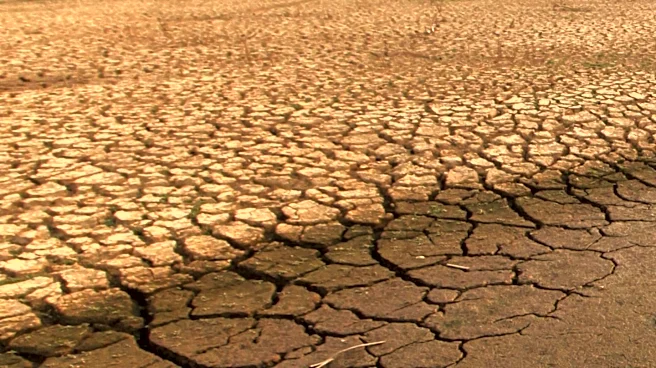
to IWMI, satellite monitoring reveals severe global groundwater depletion in regions like California’s Central Valley and the North China Plain, alongside significant greenhouse gas emissions from agricultural practices. The organization emphasizes the critical need to recognize the deep interconnectedness of water, energy, food, and environment (WEFE) resources. Researchers and policy experts convened to discuss concrete challenges and solutions, particularly in South and Southeast Asia, highlighting that the theoretical understanding of the global resource crisis is established, but the challenge lies in dismantling institutional silos and deploying targeted interventions at scale.
Why It's Important?
This call for policy precision from IWMI has significant implications for U.S. agricultural and environmental policy, particularly in regions facing severe water stress like California. The U.S. agricultural sector, a major global food producer, relies heavily on water resources, and the depletion of groundwater, as seen in California's Central Valley, poses a direct threat to food security and economic stability. Adopting a WEFE nexus approach, as suggested by IWMI, would require integrated governance across various sectors, potentially leading to more sustainable resource management and resilient food systems. For U.S. policymakers, this means moving beyond broad regulations to implement targeted interventions based on spatial intelligence, artificial intelligence, and machine learning. Such a shift could optimize water use, reduce environmental impact, and ensure the long-term viability of agricultural production, benefiting both farmers and consumers by mitigating the risks of climate change and resource depletion.
What's Next?
The IWMI's recommendations suggest a future where agricultural and water management policies are increasingly informed by advanced data analytics and localized insights. This could lead to the development and implementation of digital public infrastructures, similar to India's Agristack platform, which map individual farmer profiles and farm plot boundaries to enable targeted payments for ecosystem services. In the U.S., this might translate into increased investment in satellite telemetry, AI, and machine learning for agricultural research and policy development. Policymakers may explore transitioning from generic subsidies to more precise, performance-based incentives that encourage sustainable water use and environmental practices. Furthermore, the emphasis on integrated governance across transboundary systems, like the Mekong River Basin example, could influence how the U.S. approaches shared water resources with neighboring countries, fostering cooperative frameworks for basin-wide resilience and multi-purpose infrastructure optimization.
Beyond the Headlines
The IWMI's advocacy for policy precision underscores a profound shift in how humanity views and manages its most vital resources. Moving away from 'blanket policies' to highly localized, data-driven interventions represents an acknowledgment of the complex, heterogeneous nature of environmental challenges. This approach has ethical implications, as it seeks to ensure equitable resource distribution and sustainable practices that benefit both current and future generations. Culturally, it challenges the traditional, often top-down, approaches to resource management, promoting a more adaptive and responsive governance model. The long-term impact could be a global redefinition of agricultural productivity, where efficiency is measured not just by yield but also by ecological footprint and resource resilience. This also highlights the critical role of scientific research and technological innovation in informing policy, fostering a closer collaboration between the scientific community and governmental bodies to address existential crises.