





What's Happening?
Pieter Bruegel the Elder's painting, 'The Tower of Babel,' completed in 1563, is a significant work of the Northern Renaissance. The oil on oak panel painting, measuring approximately 114 × 155 cm, is currently housed at the Kunsthistorisches Museum in Vienna.
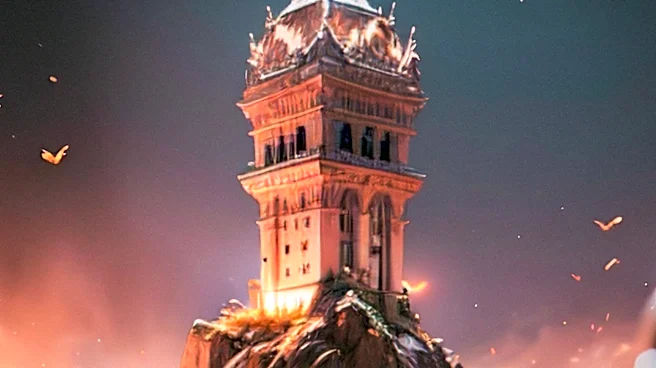
The artwork depicts the biblical narrative from Genesis 11:1–9, transforming it into a complex commentary on human ambition, technological prowess, political power, architectural grandeur, and hubris. Bruegel's meticulous detail turns the painting into a visual encyclopedia of 16th-century construction and urban life. The biblical story recounts humanity's attempt to build a tower reaching heaven, a project God disrupted by confusing their language, leading to the collapse of the construction. Bruegel focuses on the construction process itself, presenting an enormous architectural project in full operation, emphasizing collective labor rather than the moment of linguistic confusion. The tower's circular structure, inspired by the Colosseum in Rome and incorporating Gothic elements, dominates the landscape, making the human figures appear microscopic.
Why It's Important?
Bruegel's 'The Tower of Babel' serves as a timeless reflection on the paradox of human achievement. While it celebrates human ingenuity, organization, and technical knowledge, it simultaneously questions the ultimate purpose and dangers of excessive ambition. The painting's blend of Roman and Gothic architectural styles creates an imaginary structure that transcends historical accuracy, making the biblical story relevant to Bruegel's contemporary European audience. The inclusion of a city resembling 16th-century Antwerp, a major commercial and cultural hub where multiple languages were spoken, connects the ancient narrative to the social and commercial realities of his time. This artistic choice transforms the story into a warning applicable to his society, highlighting how human capabilities, while impressive, can lead to overconfidence and ultimately, failure. The painting's enduring relevance lies in its exploration of universal themes of power, labor, and the limits of human endeavor.
What's Next?
While 'The Tower of Babel' is a historical artwork, its themes continue to resonate in contemporary discussions about technological advancement, global collaboration, and the potential pitfalls of unchecked ambition. The painting's detailed depiction of construction techniques and urban life offers insights into 16th-century societal structures and engineering, which can inform historical and art historical studies. For art enthusiasts and scholars, continued analysis of Bruegel's artistic methods, such as his use of perspective and detail, and comparisons between his two surviving versions of the 'Tower of Babel' (the Vienna and Rotterdam paintings), will likely yield further understanding of his work. The painting remains a subject of ongoing interpretation regarding its ethical, cultural, and philosophical implications, prompting viewers to consider the balance between human aspiration and humility.
Beyond the Headlines
The deeper implications of 'The Tower of Babel' extend to the ethical considerations of large-scale human projects and the potential for hubris to undermine even the most impressive collective efforts. Bruegel's decision to depict the tower with architectural elements familiar to his European audience, rather than an archaeologically accurate Babylonian structure, suggests that the warning against excessive pride is not confined to a distant past but is a perpetual human condition. The painting subtly critiques the demonstration of centralized power through monumental construction, as suggested by the traditional interpretation of King Nimrod's presence. This raises questions about the relationship between political authority, collective labor, and the potential for such endeavors to become symbols of human overreach. The artwork's ability to function as a religious image, an architectural fantasy, a social panorama, and a study of human labor underscores its multifaceted commentary on the human condition and the complex interplay between ambition, technology, and societal values.