







What's Happening?
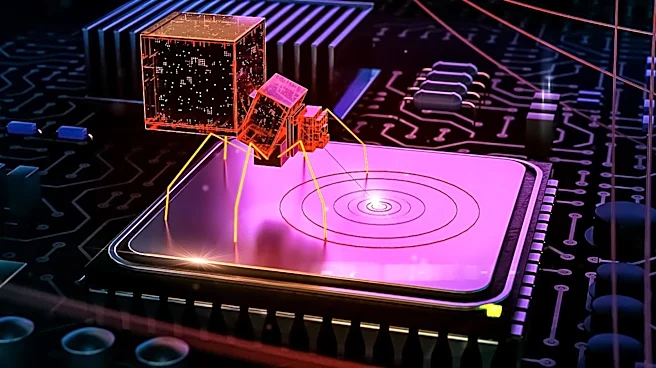
IBM, in collaboration with researchers from the University of Chicago, has announced a significant breakthrough in quantum computing. They successfully performed a quantum computation that is beyond the practical reach of leading classical simulation
techniques, completing the task in approximately 15 minutes. This achievement, detailed in their new paper 'Sampling hard circuits with verifiably high fidelity,' marks a new stage in quantum advantage. The experiment utilized a newly designed encoded quantum circuit, representing one of the largest demonstrations of logical quantum computing to date. The researchers also developed a more structured method for verifying the results, addressing a long-standing challenge in quantum computing where verifying complex quantum calculations becomes infeasible for classical computers. This method allows for error detection during the quantum computation, enhancing confidence in the reliability of the quantum computer's output. The circuits and experimental results have been made publicly available through the Quantum Advantage Tracker.
Why It's Important?
This development is crucial for the advancement of quantum computing, particularly in establishing trust and reliability in quantum systems. The ability to solve problems that are 'classically intractable' in a verifiable manner moves quantum computing beyond theoretical potential into practical application. For U.S. industries, this could unlock solutions for complex challenges in fields such as materials science, drug discovery, and financial modeling, where classical computers face computational limits. The enhanced error correction and verification techniques are vital for scaling quantum computers, making them more robust and dependable for commercial and scientific use. This milestone could accelerate investment and research in quantum technologies, positioning the U.S. at the forefront of this emerging technological frontier. Businesses and governments stand to gain from the ability to tackle previously unsolvable problems, potentially leading to new innovations and competitive advantages.
What's Next?
The success of this experiment is expected to pave the way for larger and more trustworthy quantum computers. The public availability of the circuits and experimental results through the Quantum Advantage Tracker will allow other researchers and developers to build upon this foundation, fostering further innovation in the field. Future efforts will likely focus on refining error correction techniques, increasing the number of logical qubits, and exploring new applications for these advanced quantum capabilities. The ability to verify quantum computations with high fidelity will be critical for gaining broader acceptance and adoption of quantum technology across various sectors. This breakthrough could also stimulate further collaboration between academic institutions and technology companies, accelerating the transition of quantum computing from research labs to real-world problem-solving tools.
Beyond the Headlines
This achievement has profound implications beyond immediate computational speed. The focus on verifiable high fidelity addresses a fundamental challenge in quantum computing: how to trust the results of a quantum machine when classical computers cannot replicate or check them. By developing methods to detect errors and establish statistical confidence in the output, IBM and the University of Chicago are building a framework for the ethical and reliable deployment of quantum technology. This shift from merely demonstrating quantum speed to ensuring quantum trustworthiness is essential for long-term societal impact. It could influence regulatory frameworks for quantum computing, intellectual property considerations for quantum algorithms, and the development of a skilled workforce capable of operating and interpreting quantum systems. The ethical dimension of ensuring reliable and verifiable quantum computations will become increasingly important as these powerful machines become more prevalent.