



What's Happening?
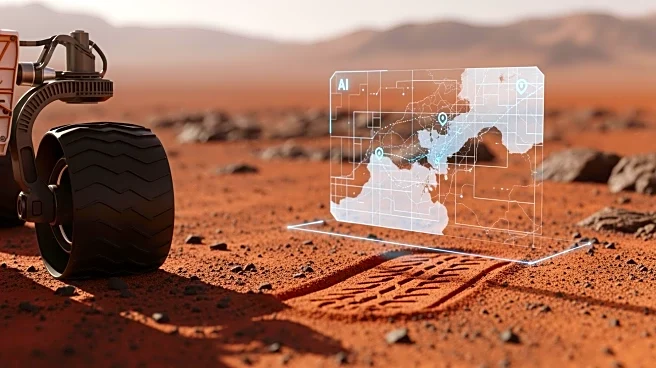
NASA has successfully employed Anthropic's Claude chatbot, a large language model, to plot a route for its Perseverance rover on Mars. This marks the first instance of NASA using such AI technology to pilot the rover, which traversed approximately 400
meters through the Jezero crater. The process involved providing Claude with extensive contextual data from the rover's previous missions. NASA's Jet Propulsion Laboratory (JPL) engineers verified the AI-generated waypoints through simulations to ensure accuracy, making only minor adjustments. This collaboration aims to enhance efficiency in route planning, allowing for more scientific data collection and analysis.
Why It's Important?
The integration of AI in NASA's operations signifies a significant advancement in space exploration technology. By reducing the time required for manual route planning, NASA can allocate more resources to scientific research and data collection. This efficiency is crucial, especially in light of recent budget constraints and workforce reductions. The successful use of AI models like Claude could pave the way for more autonomous space missions, potentially exploring further reaches of the solar system. For Anthropic, this achievement demonstrates the rapid development and application of their AI models in complex real-world scenarios.
What's Next?
NASA is likely to continue exploring the use of AI in its missions, potentially expanding the role of autonomous systems in space exploration. Future collaborations with AI developers could lead to more sophisticated models capable of handling increasingly complex tasks. As NASA aims to return to the Moon and beyond, the integration of AI could become a cornerstone of its strategy, especially given the current workforce and budgetary challenges. The success of this mission may encourage other space agencies to adopt similar technologies.
Beyond the Headlines
The use of AI in space exploration raises questions about the ethical implications of autonomous decision-making in critical missions. As AI systems become more integral to space operations, ensuring transparency and accountability in their decision-making processes will be essential. Additionally, the reliance on AI could shift the skill sets required for future space missions, emphasizing the need for expertise in AI and machine learning alongside traditional engineering and scientific skills.