









What's Happening?
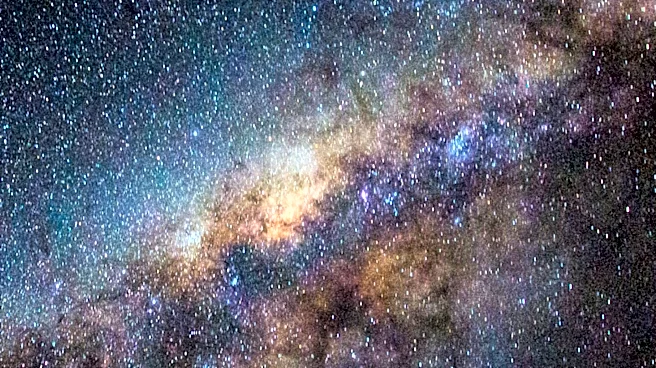
Researchers from the University of Vienna and Lawrence Berkeley National Laboratory have employed machine learning to revisit the Galactic Center Excess (GCE), a mysterious gamma-ray glow surrounding the Milky Way's core. This glow has puzzled scientists
for over a decade, with debates centering on its origin. The new study, published in Physical Review Letters, suggests that dark matter remains a plausible explanation for the GCE. The research team developed a machine-learning system that analyzed over a million simulated gamma-ray observations, considering both the spatial distribution and the energies of individual photons. This approach challenges previous studies that favored the pulsar explanation, suggesting that if point sources are responsible, they would need to be extremely faint. The findings indicate that the number of millisecond pulsars required to account for the glow would be significantly higher than previously assumed, keeping dark matter as a viable candidate.
Why It's Important?
The study's findings are significant as they challenge existing theories about the Galactic Center Excess and keep the dark matter hypothesis in play. Dark matter, a hypothetical form of matter that constitutes a large part of the universe's mass, has never been directly detected. This research underscores the complexity of astrophysical phenomena and the need for advanced analytical techniques like machine learning to explore them. The implications extend to our understanding of the universe's composition and the fundamental forces at play. If dark matter is indeed responsible for the GCE, it could provide crucial insights into its properties and behavior, influencing future research directions in astrophysics and cosmology.
What's Next?
The study opens new avenues for further research into the Galactic Center Excess and the role of dark matter. Future investigations may focus on refining machine learning models and incorporating additional data to enhance the accuracy of predictions. The scientific community may also explore alternative explanations for the GCE, considering other potential sources of gamma-ray emissions. Continued advancements in observational technology and data analysis techniques will be crucial in resolving this longstanding mystery. The findings may prompt collaborations between astrophysicists and data scientists to develop innovative approaches for studying complex cosmic phenomena.