




What's Happening?
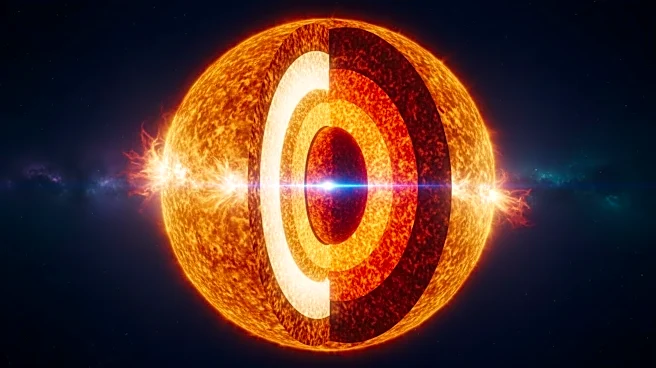
NASA's COFFIES (Consequences Of Fields and Flows in the Interior and Exterior of the Sun) Science Center has made significant progress in understanding the sun's tachocline layer. This thin region, located between the sun's radiative and convective zones,
plays a crucial role in the solar dynamo process that generates magnetic fields. The COFFIES team has refined computer models to better understand the tachocline's formation and function, revealing its importance in driving solar activity and space weather. The research aims to improve predictive models of space weather, which can impact satellite communications and astronaut safety.
Why It's Important?
The tachocline's role in the solar dynamo is vital for understanding solar activity and its effects on space weather. By advancing knowledge of this layer, NASA's COFFIES Center contributes to more accurate predictions of solar flares and coronal mass ejections. These events can disrupt satellite operations, power grids, and communication systems on Earth. The research also enhances our understanding of the sun's internal processes, which is essential for developing strategies to mitigate the impacts of space weather on technology and infrastructure.
What's Next?
The COFFIES team will continue to refine their models and conduct further studies to explore the tachocline's dynamics. Future research will focus on the interactions between magnetic fields and plasma flows within the sun, aiming to improve the accuracy of space weather forecasts. The findings will inform the development of new technologies and strategies to protect critical infrastructure from solar activity. The ongoing research will also contribute to the broader field of heliophysics by providing insights into the sun's complex internal processes.