






What's Happening?
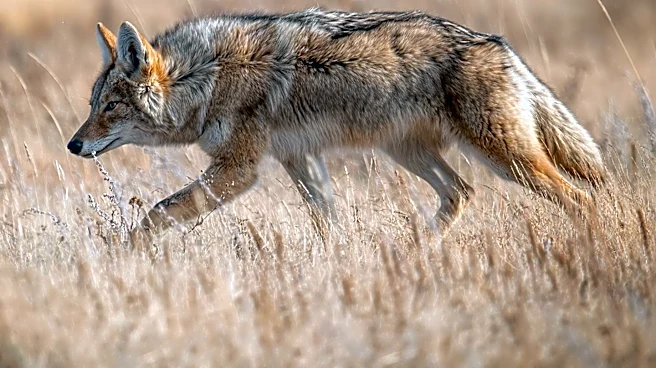
A recent study published in the Journal of Wildlife Management indicates that coyotes remain established on North Carolina's Outer Banks, with an estimated population of 45 to 61 individuals across the barrier-island study area. This finding comes despite
years of efforts to remove the animals. Researchers from North Carolina State University, who summarized the work, noted that 62 individual coyotes were identified during the study. The research provides a rare population estimate for a species that is typically challenging to count due to its adaptability and ability to navigate diverse landscapes, including developed areas, marshes, beaches, and protected lands. The study emphasizes that the persistence of the coyote population does not necessarily mean removal efforts were entirely ineffective, but rather highlights the difficulty of eradication when animals can move into an area, avoid detection, or reproduce. The findings offer wildlife managers a clearer baseline for evaluating future decisions regarding coyote management.
Why It's Important?
The study's findings are significant for wildlife management and public policy in coastal regions. It shifts the conversation from assumptions about eradication to measurable goals, allowing communities to define objectives such as reducing encounters, protecting specific resources, or lowering population numbers. This distinction is crucial in public debates about wildlife control, as removing individual animals does not guarantee population eradication, and impacts can be temporary or offset by reproduction and immigration. For residents and visitors, the study serves as a reminder that coyotes are a permanent part of the Outer Banks ecosystem, underscoring the importance of coexistence practices like securing food and trash, supervising pets, and following local wildlife authority guidance. The research also highlights the complexities of managing wildlife in barrier island settings, where geographical features allow for movement and recolonization, necessitating coordinated monitoring over isolated removal efforts.
What's Next?
The study establishes a baseline for future monitoring and evaluation of coyote management strategies on the Outer Banks. The next steps involve repeated, comparable surveys to determine if population estimates change, if coyotes shift their distribution, and if human-wildlife conflicts increase or decrease. Managers will need to ensure consistent methodologies to accurately track population dynamics. Furthermore, there is a need to link population abundance to conflict levels, requiring detailed reports of encounters to inform targeted responses. The study suggests that evaluating management programs should encompass both ecological outcomes, such as coyote population estimates, and community outcomes, including reports of encounters and the effectiveness of prevention measures. This comprehensive approach will help residents understand the true impact of management efforts and identify areas where alternative strategies, such as community education on reducing attractants, may be necessary.
Beyond the Headlines
The persistence of coyotes on the Outer Banks, despite human intervention, underscores broader ecological principles about species adaptability and the challenges of human-wildlife coexistence. It highlights the limitations of eradication as a sole management strategy, particularly for resilient species in dynamic environments. The study implicitly raises ethical questions about the extent of human intervention in natural ecosystems and the definition of 'acceptable' wildlife presence. Legally, it may influence local ordinances and resource allocation for wildlife management, pushing for more data-driven and nuanced approaches rather than reactive measures. Culturally, it challenges the perception of wildlife as something to be controlled or eliminated, encouraging a shift towards understanding and coexisting with native species. This development could also trigger long-term shifts in how coastal communities approach conservation, emphasizing integrated management plans that consider ecological connectivity and long-term sustainability over short-term removal efforts.